Networking 09 — Designing a Network in Eight Steps (with Five Case Studies)
Requirements, topology per tier, components, media limits, addressing plan, uplink sizing, failure design and security zones — then a complete worked design and five case studies.
These notes began as two handwritten notebooks for COM 3401 — Data Communication and Networking at Rajarata University. I OCR'd them, rewrote them in English, and paired every section with a Sinhala explanation so the concept comes first and the English terms stay intact for the exam. Diagrams are redrawn as vector graphics.
Step 1 — Gather the requirements
පියවර 1 — අවශ්යතා එකතු කිරීම
A network is not bought, it is designed. You start from what the organisation actually does, you turn that into numbers, and only then do you choose the boxes and the cables. This part walks through that process in the order a real design follows, and ends with a complete worked design for a three floor faculty building.
සිංහලෙන්: ජාලයක් මිල දී ගෙන නැත, එය නිර්මාණය කර ඇත. ඔබ සංවිධානය ඇත්ත වශයෙන්ම කරන දෙයින් ආරම්භ කරන්න, ඔබ එය අංක බවට පත් කරන්න, පසුව පමණක් ඔබ පෙට්ටි සහ කේබල් තෝරාගන්න. මෙම කොටස සැබෑ සැලසුමක් අනුගමනය කරන අනුපිළිවෙලට එම ක්රියාවලිය හරහා ගමන් කරන අතර තට්ටු තුනක පීඨ ගොඩනැගිල්ලක් සඳහා සම්පූර්ණ වැඩ කරන ලද සැලසුමකින් අවසන් වේ.
Before any device is chosen, four groups of numbers must be written down, because every later decision depends on them.
සිංහලෙන්: ඕනෑම උපාංගයක් තෝරා ගැනීමට පෙර, අංක කණ්ඩායම් හතරක් ලියා තැබිය යුතුය, මන්ද පසුකාලීන සෑම තීරණයක්ම ඒවා මත රඳා පවතී.
- User count per location, today and after five years of growth. A design that fits exactly today is already obsolete.
- The applications that will run, and for each one whether it is bandwidth hungry, delay sensitive, or loss sensitive. File backup is bandwidth hungry, voice is delay sensitive, and a database transaction is loss sensitive.
- The availability target, written as a percentage of uptime, because that single number decides how much redundancy you must pay for.
- The security boundary, that is, which groups of users must not be able to reach each other directly, because that decides the number of subnets and firewalls.
සිංහලෙන්: - අද සහ වසර පහක වර්ධනයෙන් පසුව, එක් ස්ථානයකට පරිශීලක සංඛ්යාව. අදට හරියටම ගැලපෙන නිර්මාණයක් දැනටමත් යල්පැන ගොස් ඇත.
- ක්රියාත්මක වන යෙදුම්, සහ එක් එක් ඒවා සඳහා කලාප පළල බඩගිනි, ප්රමාද සංවේදී හෝ අලාභ සංවේදී වේ. ගොනු උපස්ථය කලාප පළල බඩගිනි වේ, හඬ ප්රමාද සංවේදී වේ, සහ දත්ත සමුදා ගනුදෙනුවක් පාඩු සංවේදී වේ.
- ලබා ගැනීමේ ඉලක්කය, අතිකාලයේ ප්රතිශතයක් ලෙස ලියා ඇත, මන්ද එම තනි අංකය ඔබ කොපමණ අතිරික්තයක් සඳහා ගෙවිය යුතුද යන්න තීරණය කරයි.
- ආරක්ෂක මායිම, එනම්, කුමන පරිශීලක කණ්ඩායම්වලට සෘජුවම එකිනෙකා වෙත ළඟා වීමට නොහැකි විය යුතුද යන්න, එය උපජාල සහ ෆයර්වෝල් ගණන තීරණය කරන බැවිනි.
Typical per-user bandwidth budget used for sizing
| Application | Per user | Sensitive to |
|---|---|---|
| Web browsing and email | 0.1 Mbps | nothing in particular |
| Cloud file sync and backup | 1.0 Mbps | bandwidth |
| Voice over IP call (G.711) | 0.087 Mbps | delay and jitter |
| Video conference (720p) | 1.5 Mbps | delay and loss |
| Lab software, virtual machines | 2.0 Mbps | bandwidth |
Step 2 — Choose the topology for each tier
පියවර 2 — එක් එක් තට්ටුව සඳහා ටොපොලොජිය තෝරන්න
A real campus is never one topology. It is a hierarchy of three tiers, and each tier uses the topology that suits its job, which is why the hierarchical design is sometimes called the three layer model.
සිංහලෙන්: සැබෑ කැම්පස් එකක් කිසිවිටෙක එක් ස්ථලකයක් නොවේ. එය ස්ථර තුනක ධුරාවලියක් වන අතර, සෑම ස්ථරයක්ම එහි කාර්යයට ගැලපෙන ස්ථලකය භාවිතා කරයි, එබැවින් ධුරාවලියේ සැලසුම සමහර විට තට්ටු තුනේ ආකෘතිය ලෙස හැඳින්වේ.
- The access tier is where end devices plug in. It is a star, because a star keeps one broken cable from affecting anybody else and lets you find a fault by looking at one port.
- The distribution tier aggregates the access switches of a floor or a building, applies the access control rules, and is the boundary between layer two and layer three.
- The core tier moves traffic between distribution blocks as fast as possible and does nothing else. It is a partial mesh, because the core is where a single failure would hurt the most.
සිංහලෙන්: - ප්රවේශ ටයරය යනු අවසාන උපාංග ප්ලග් ඉන් වන ස්ථානයයි. එය තරුවකි, මන්ද තරුවක් එක් කැඩුණු කේබලයක් වෙනත් කිසිවකුට බල නොපාන ලෙස තබා ගන්නා අතර එක් වරායක් දෙස බැලීමෙන් ඔබට දෝෂයක් සොයා ගැනීමට ඉඩ සලසයි.
- බෙදාහැරීමේ ස්ථරය මහලක හෝ ගොඩනැඟිල්ලක ප්රවේශ ස්විචයන් එකතු කරයි, ප්රවේශ පාලන නීති අදාළ කරයි, සහ ස්ථර දෙක සහ තුන්වන ස්ථරය අතර මායිම වේ.
- මූලික ස්ථරය හැකිතාක් වේගයෙන් බෙදා හැරීමේ කොටස් අතර ගමනාගමනය ගෙන යන අතර වෙන කිසිවක් නොකරයි. එය පාර්ශවීය දැලකි, මන්ද යත් එක් අසාර්ථකත්වයක් වැඩිපුරම රිදවන ස්ථානය හරයයි.
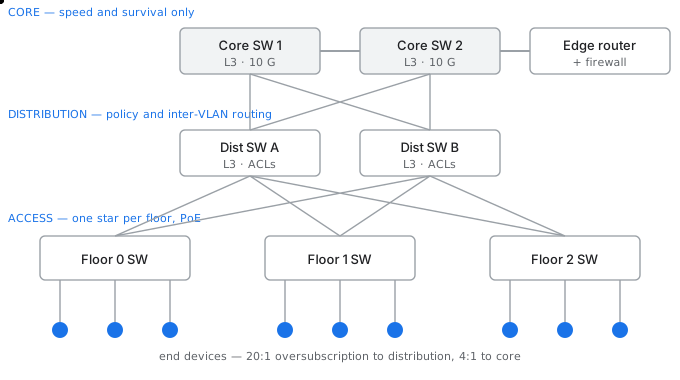
Three-tier campus design — access, distribution, core
The rule of thumb is that the access tier optimises for cost per port, the distribution tier optimises for policy, and the core tier optimises for speed and survival. Putting an access control list in the core is a classic design error, because it slows down the one place that must never slow down.
සිංහලෙන්: මාපටැඟිල්ලේ රීතිය වන්නේ ප්රවේශ ස්ථරය එක් වරායකට පිරිවැය සඳහා ප්රශස්ත කිරීම, බෙදා හැරීමේ ස්ථරය ප්රතිපත්ති සඳහා ප්රශස්ත කිරීම සහ මූලික ස්ථරය වේගය සහ පැවැත්ම සඳහා ප්රශස්ත කිරීමයි. ප්රවේශ පාලන ලැයිස්තුවක් හරයේ තැබීම සම්භාව්ය නිර්මාණ දෝෂයකි, මන්ද එය කිසි විටෙකත් මන්දගාමී නොවිය යුතු එක් ස්ථානය මන්දගාමී කරයි.
Step 3 — Select the components
පියවර 3 — අංග තෝරා ගැනීම
Each device operates at a particular layer, and that layer determines what it can and cannot do. Choosing a device one layer too low is the most common and most expensive mistake in a student design.
සිංහලෙන්: සෑම උපාංගයක්ම නිශ්චිත ස්ථරයක ක්රියාත්මක වන අතර, එම ස්තරය එයට කළ හැකි සහ කළ නොහැකි දේ තීරණය කරයි. එක් ස්ථරයක් ඉතා අඩුවෙන් උපාංගයක් තෝරා ගැනීම ශිෂ්ය නිර්මාණයක වඩාත් පොදු සහ මිල අධිකම වැරැද්දයි.
Component selection reference
| Component | Layer | Forwards using | Collision domains | Broadcast domains | Use it when |
|---|---|---|---|---|---|
| Repeater | 1 Physical | nothing, regenerates bits | 1 | 1 | the cable run exceeds the distance limit |
| Hub | 1 Physical | nothing, floods all ports | 1 | 1 | never in a new design |
| Bridge | 2 Data link | MAC address | one per port | 1 | joining two legacy segments |
| Switch | 2 Data link | MAC address | one per port | 1 per VLAN | the access tier, always |
| Layer 3 switch | 2 and 3 | MAC and IP | one per port | 1 per VLAN | the distribution tier |
| Router | 3 Network | IP address | one per port | one per port | joining different networks or the WAN |
| Firewall | 3 to 7 | IP, port, session, content | one per port | one per port | between security zones |
| Load balancer | 4 to 7 | service address and health | one per port | one per port | one service, several servers |
| Wireless access point | 1 and 2 | MAC address | 1 shared radio | 1 per SSID | mobile users |
| Modem | 1 Physical | nothing, modulates | n/a | n/a | the link to the provider is analog |
Two numbers in that table decide the shape of the design. Every port of a switch is its own collision domain, which is why collisions effectively disappeared when hubs were replaced by switches. But a switch still floods a broadcast to every port in the same VLAN, so only a router, or a layer three switch acting as one, can break a broadcast domain.
සිංහලෙන්: එම වගුවේ ඇති ඉලක්කම් දෙකක් නිර්මාණයේ හැඩය තීරණය කරයි. ස්විචයක සෑම වරායක්ම එහිම ඝට්ටන වසමකි, එම නිසා හබ් ස්විච මගින් ප්රතිස්ථාපනය කළ විට ගැටුම් ඵලදායී ලෙස අතුරුදහන් විය. නමුත් ස්විචයක් තවමත් එකම VLAN හි සෑම වරායකටම විකාශනය කරයි, එබැවින්රවුටරයකට හෝ එකක් ලෙස ක්රියා කරන ස්ථර තුනේ ස්විචයකට පමණක් විකාශන වසමක් බිඳ දැමිය හැකිය.
Step 4 — Pick the medium and respect its limits
පියවර 4 — මාධ්යය තෝරා එහි සීමා අනුගමනය කරන්න
The cabling outlives every other component in the design, often by fifteen years, so it is the one decision that is expensive to get wrong. Each medium has a hard distance limit that comes from physics, not from the vendor.
සිංහලෙන්: බොහෝ විට වසර පහළොවකින් නිර්මාණයේ ඇති අනෙකුත් සෑම අංගයක්ම කේබල් කිරීම ඉක්මවා යයි, එබැවින් වැරදි කිරීමට මිල අධික වන්නේ එකම තීරණයයි. සෑම මාධ්යයකටම වෙළෙන්දාගෙන් නොව භෞතික විද්යාවෙන් එන දෘඩ දුර සීමාවක් ඇත.
Transmission media and their working limits
| Medium | Typical rate | Max distance | Immunity to noise | Use it for |
|---|---|---|---|---|
| UTP Cat5e | 1 Gbps | 100 m | low | legacy desk drops |
| UTP Cat6 | 1 Gbps, 10 Gbps to 55 m | 100 m | low to medium | the access tier |
| STP Cat6a | 10 Gbps | 100 m | medium to high | factory and lab floors |
| Multimode fibre OM4 | 10 to 100 Gbps | 400 m at 10 Gbps | total | building risers, floor to floor |
| Single mode fibre OS2 | 10 to 400 Gbps | 10 km and beyond | total | between buildings, to the ISP |
| Coaxial | 10 to 100 Mbps | 185 to 500 m | medium | legacy and cable TV access |
| Wireless 802.11ax | up to 1.2 Gbps shared | 35 m indoors | poor | mobility, never for servers |
The hundred metre limit of twisted pair includes the patch cords at both ends, so the horizontal run inside the wall should be planned at ninety metres. That single rule is what decides how many wiring closets a floor needs.
සිංහලෙන්: ඇඹරුණු යුගලයේ මීටර් සියයේ සීමාවට දෙපැත්තේ ඇති පැච් ලණු ඇතුළත් වේ, එබැවින් බිත්තිය ඇතුළත තිරස් දිවීම මීටර් අනූවකින් සැලසුම් කළ යුතුය. මහලකට අවශ්ය වයරින් අල්මාරි කීයක් තීරණය කරන්නේ එම තනි රීතියයි.
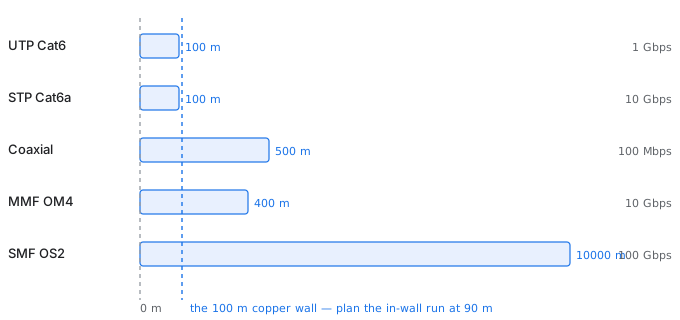
Media and their working distance limits
Step 5 — Design the addressing plan
පියවර 5 — ලිපින සැලැස්ම සැලසුම් කිරීම
An addressing plan is not a list of free addresses handed out as people ask. It is a structure decided in advance, so that a single summarised route can describe a whole building and a firewall rule can describe a whole department.
සිංහලෙන්: ලිපින සැලැස්මක් යනු මිනිසුන් ඉල්ලා සිටින පරිදි නොමිලේ ලබා දෙන ලිපින ලැයිස්තුවක් නොවේ. එය කල්තියා තීරණය කරන ලද ව්යුහයක් වන අතර, එක් සාරාංශගත මාර්ගයකට සම්පූර්ණ ගොඩනැගිල්ලක් විස්තර කළ හැකි අතර ෆයර්වෝල්රීතියකට සම්පූර්ණ දෙපාර්තමේන්තුවක් විස්තර කළ හැකිය.
- Give every subnet a size that is the next power of two above the required host count, plus room for growth. Never size a subnet exactly.
- Allocate the largest subnet first, then the next largest. Allocating a small subnet in the middle of the block fragments the space and prevents summarisation.
- Keep one bit of structure per level of the hierarchy, so that building, floor and function can each be read off the address.
- Reserve a block for infrastructure, that is, switch management addresses, router interfaces and access points, and keep it out of the user space.
සිංහලෙන්: - සෑම උපජාලයකටම අවශ්ය ධාරක සංඛ්යාවට වඩා ඊළඟ බලය දෙකේ ප්රමාණය, සහ වර්ධනය සඳහා ඉඩ දෙන්න. කිසි විටෙක උපජාලයක් හරියටම ප්රමාණය නොකරන්න.
- පළමුව විශාලතම උපජාලය වෙන් කරන්න, ඊළඟට විශාලතම උපජාලය. බ්ලොක් මැද කුඩා උපජාලයක් වෙන් කිරීම අවකාශය ඛණ්ඩනය කර සාරාංශ කිරීම වළක්වයි.
- ධූරාවලියේ මට්ටමට එක් ව්යුහයක් තබා ගන්න, එවිට ගොඩනැගිල්ල, බිම සහ ක්රියාකාරීත්වය යන සෑම එකක්ම ලිපිනයෙන් කියවිය හැක.
- යටිතල පහසුකම් සඳහා බ්ලොක් එකක් වෙන් කරන්න, එනම් කළමනාකරණ ලිපින, රවුටර අතුරුමුහුණත් සහ ප්රවේශ ස්ථාන මාරු කර එය පරිශීලක අවකාශයෙන් බැහැරව තබන්න.
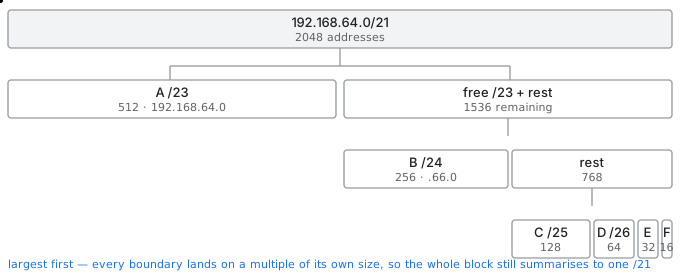
Splitting 192.168.64.0/21 largest-first
Step 6 — Size the uplinks
පියවර 6 — ඉහළ සම්බන්ධතා විශාලත්වය තීරණය කිරීම
An uplink does not need to carry the sum of everything below it, because not every user transmits at once. Designers use an oversubscription ratio, that is, the ratio of the total access capacity to the uplink capacity.
සිංහලෙන්: සෑම පරිශීලකයෙක්ම එකවර සම්ප්රේෂණය නොකරන නිසා, uplink එකකට ඊට පහළින් ඇති සියල්ලේ එකතුව රැගෙන යාමට අවශ්ය නොවේ. නිර්මාණකරුවන් අධි දායකත්ව අනුපාතයක් භාවිතා කරයි, එනම්, සම්පූර්ණ ප්රවේශ ධාරිතාවේ uplink ධාරිතාවට අනුපාතය.
- Access to distribution is commonly designed at twenty to one, because desk traffic is bursty and mostly idle.
- Distribution to core is commonly designed at four to one, because it already carries the aggregate of many bursts, which is much smoother.
- Server and storage links are designed at one to one, because a backup window really does use the whole link for hours.
සිංහලෙන්: - බෙදා හැරීමට ප්රවේශය සාමාන්යයෙන් විස්සේ සිට එක දක්වා සැලසුම් කර ඇත, මන්ද මේස ගමනාගමනය පුපුරා ගොස් ඇති අතර බොහෝ දුරට අක්රිය වේ.
- හරය වෙත බෙදා හැරීම සාමාන්යයෙන් හතරේ සිට එක දක්වා සැලසුම් කර ඇත, මන්ද එය දැනටමත් බොහෝ පිපිරුම්වල එකතුව ගෙන යන අතර එය වඩාත් සුමට වේ.
- සේවාදායක සහ ගබඩා සබැඳි එකින් එක ලෙස නිර්මාණය කර ඇත, මන්ද උපස්ථ කවුළුවක් ඇත්ත වශයෙන්ම සම්පූර්ණ සබැඳිය පැය ගණනක් භාවිතා කරයි.
Step 7 — Design for failure
පියවර 7 — අසාර්ථකත්වය සඳහා සැලසුම් කිරීම
Availability is decided by the topology, not by buying more reliable boxes. Two components in series multiply their availabilities, so the pair is always worse than either one. Two components in parallel multiply their unavailabilities, so the pair is always better than either one.
සිංහලෙන්: පවතින බව තීරණය වන්නේ ස්ථලකය මත මිස වඩා විශ්වාසදායක පෙට්ටි මිලදී ගැනීමෙන් නොවේ. ශ්රේණියේ ඇති සංරචක දෙකක් ඒවායේ ඇති හැකියාව ගුණ කරයි, එබැවින් යුගලය සෑම විටම එකකට වඩා නරක ය. සංරචක දෙකක් සමාන්තරව ඒවායේ නොපවතින බව ගුණ කරයි, එබැවින් යුගලය සෑම විටම එකකට වඩා හොඳය.
Availability arithmetic
series   A_total = A1 x A2 x ... x An
parallel A_total = 1 - (1 - A1)(1 - A2)...(1 - An)

one router at 99.0%  ->  unavailable 1.0%   = 87.6 hours per year
two in series        ->  0.99 x 0.99 = 98.01%  = 174.4 hours per year
two in parallel      ->  1 - 0.01 x 0.01 = 99.99% = 0.88 hours per year
That is the whole argument for redundancy in three lines. Duplicating the router improves the yearly downtime by a factor of one hundred, while adding a second device in the path without redundancy doubles the downtime.
සිංහලෙන්: පේළි තුනකින් අතිරික්තය සඳහා වන සම්පූර්ණ තර්කය එයයි. රවුටරය අනුපිටපත් කිරීම වාර්ෂික අක්රීය කාලය සිය ගුණයකින් වැඩි දියුණු කරන අතර, අතිරික්තයකින් තොරව දෙවන උපාංගයක් මාර්ගයට එක් කිරීම අක්රීය කාලය දෙගුණ කරයි.
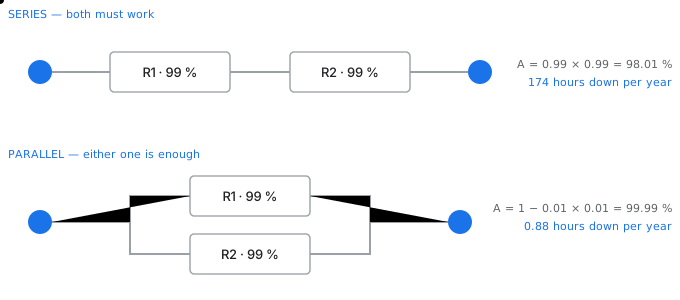
Series multiplies availability; parallel multiplies unavailability
Step 8 — Draw the security zones
පියවර 8 — ආරක්ෂක කලාප ඇඳීම
A security zone is a group of systems that trust each other to the same degree. Traffic moves freely inside a zone and is inspected between zones, so the number of firewall interfaces follows directly from the number of zones.
සිංහලෙන්: ආරක්ෂක කලාපයක් යනු එකිනෙකා එකම මට්ටමකට විශ්වාස කරන පද්ධති සමූහයකි. ගමනාගමනය කලාපයක් තුළ නිදහසේ ගමන් කරන අතර කලාප අතර පරීක්ෂා කරනු ලැබේ, එබැවින් ෆයර්වෝල් අතුරුමුහුණත් ගණන කලාප ගණනින් කෙලින්ම අනුගමනය කරයි.
- The outside zone is the internet, and nothing in it is trusted.
- The demilitarised zone holds the servers that outsiders must reach, that is the web server, the public DNS and the mail relay. It may be reached from outside, but it may not open connections into the inside.
- The inside zone holds the staff and student networks, which may reach out but may not be reached from outside.
- The management zone holds the switch and router management addresses and the monitoring server, and it is reachable only from a jump host.
සිංහලෙන්: - පිටත කලාපය අන්තර්ජාලය වන අතර, එහි කිසිවක් විශ්වාස නැත.
- හමුදාකරණය කළ කලාපය තුළ පිටස්තරයින් ළඟා විය යුතු සේවාදායකයන්රඳවා තබා ගනී, එනම් වෙබ් සේවාදායකය, පොදු DNS සහ තැපැල්රිලේ ය. එය පිටතින් ළඟා විය හැකි නමුත් එය ඇතුළත සම්බන්ධතා විවෘත නොකළ හැකිය.
- අභ්යන්තර කලාපය කාර්ය මණ්ඩලය සහ ශිෂ්ය ජාලයන් දරයි, ඒවා ළඟා විය හැකි නමුත් පිටතින් ළඟා නොවිය හැකිය.
- කළමනාකරණ කලාපය ස්විචය සහ රවුටර කළමනාකරණ ලිපින සහ අධීක්ෂණ සේවාදායකය තබා ඇති අතර, එය ළඟා විය හැක්කේ ජම්ප් සත්කාරකයෙකුගෙන් පමණි.
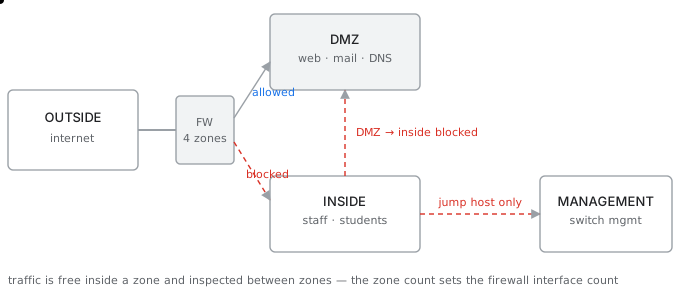
Four security zones and the permitted directions
The complete worked design
සම්පූර්ණ සැලසුම
The Faculty of Applied Sciences needs a network for a three floor building. The ground floor holds 60 staff, the first floor holds 120 students in two laboratories, and the second floor holds 40 research users plus 6 servers. The faculty has been given the address block 172.20.16.0 slash 22 and a 200 Mbps internet link. The design below follows the eight steps above.
සිංහලෙන්: ව්යවහාරික විද්යා පීඨයට තට්ටු තුනක ගොඩනැගිල්ලක් සඳහා ජාලයක් අවශ්යයි. බිම් මහලේ කාර්ය මණ්ඩලය 60 ක් ද, පළමු මහලේ රසායනාගාර දෙකක සිසුන් 120 ක් ද, දෙවන මහලේ පර්යේෂණ පරිශීලකයින් 40 ක් සහ සේවාදායක 6 ක් ද සිටී. පීඨයට 172.20.16.0 slash 22 යන ලිපිනය සහ 200 Mbps අන්තර්ජාල සබැඳියක් ලබා දී ඇත. පහත නිර්මාණය ඉහත පියවර අට අනුගමනය කරයි.
Requirement summary
floor 2   research 40 users + servers 6      growth x1.5 -> 60 + 8
floor 1   student labs 120 users            growth x1.5 -> 180
floor 0   staff 60 users                    growth x1.5 -> 90
          wireless, all floors, 120 devices  growth x1.5 -> 180
          infrastructure (switch mgmt, APs)              -> 30

peak internet demand  = 220 users x 1.0 Mbps typical mix
                      = 220 Mbps offered, 200 Mbps link, 1.1 : 1
                      -> acceptable, traffic is bursty; add shaping for backups
The address block 172.20.16.0 slash 22 contains 1024 addresses. The subnets are allocated largest first, exactly as step five requires.
සිංහලෙන්: ලිපින වාරණ 172.20.16.0 slash 22 හි ලිපින 1024 ක් අඩංගු වේ. පස්වන පියවරට අවශ්ය වන පරිදි, උපජාල මුලින්ම විශාලතම වෙන් කරනු ලැබේ.
Address allocation for the faculty building
| Subnet | Need | Size | Prefix | Network | Usable range | Broadcast |
|---|---|---|---|---|---|---|
| Student labs, floor 1 | 180 | 256 | /24 | 172.20.16.0 | 172.20.16.1 – .254 | 172.20.16.255 |
| Wireless, all floors | 180 | 256 | /24 | 172.20.17.0 | 172.20.17.1 – .254 | 172.20.17.255 |
| Staff, floor 0 | 90 | 128 | /25 | 172.20.18.0 | 172.20.18.1 – .126 | 172.20.18.127 |
| Research, floor 2 | 60 | 64 | /26 | 172.20.18.128 | 172.20.18.129 – .190 | 172.20.18.191 |
| Infrastructure, mgmt | 30 | 32 | /27 | 172.20.18.192 | 172.20.18.193 – .222 | 172.20.18.223 |
| Servers, DMZ | 8 | 16 | /28 | 172.20.18.224 | 172.20.18.225 – .238 | 172.20.18.239 |
| Router to router links | 2 each | 4 | /30 | 172.20.18.240 + | two usable per link | every fourth address |
| Spare | — | 256 | /24 | 172.20.19.0 | held for growth | — |
Notice that the whole building is still describable by the single summary route 172.20.16.0 slash 22, because the plan never allocated out of order. That is the practical payoff of designing the addressing rather than handing it out.
සිංහලෙන්: සැලැස්ම කිසි විටෙක ක්රියා විරහිතව වෙන් කර නොමැති නිසා, සම්පූර්ණ ගොඩනැගිල්ල තවමත් තනි සාරාංශ මාර්ගය 172.20.16.0 slash 22 මගින් විස්තර කළ හැකි බව සලකන්න. එය බෙදා හැරීමට වඩා ආමන්ත්රණය සැලසුම් කිරීමේ ප්රායෝගික විපාකය එයයි.
Bill of components
| Tier | Component | Quantity | Why this device and not a cheaper one |
|---|---|---|---|
| Access, floor 0 | 24 port L2 switch, 1 Gbps, PoE | 4 | PoE feeds the access points; 96 ports for 90 staff plus spares |
| Access, floor 1 | 48 port L2 switch, 1 Gbps, PoE | 4 | 180 lab ports; lab traffic is heavy so uplinks are doubled |
| Access, floor 2 | 24 port L2 switch, 1 Gbps, PoE | 3 | 60 research ports plus access points |
| Distribution | L3 switch, 10 Gbps uplinks | 2 | inter VLAN routing and the access control lists live here; two for redundancy |
| Core | L3 switch, 10 Gbps, partial mesh | 2 | only forwarding, no policy, dual for survival |
| Server access | 24 port switch, 10 Gbps | 2 | servers are sized one to one, not oversubscribed |
| Edge | Router with two WAN ports | 1 | terminates the 200 Mbps link and a backup link |
| Security | Firewall, four zones | 1 pair | outside, DMZ, inside and management interfaces |
| Wireless | 802.11ax access point | 12 | one per 15 concurrent users, not one per room |
| Cabling, horizontal | UTP Cat6 | ≈ 330 drops | 90 m planned run keeps every drop inside the 100 m limit |
| Cabling, riser | OM4 multimode fibre, 12 core | 3 runs | floor to floor, immune to the lift motor noise |
| Cabling, external | OS2 single mode fibre | 1 run | to the provider, 10 km capable |
Uplink sizing check, floor 1 (the worst case)
access capacity  = 4 switches x 48 ports x 1 Gbps = 192 Gbps
target ratio     = 20 : 1
required uplink  = 192 / 20 = 9.6 Gbps
chosen uplink    = 2 x 10 Gbps to two distribution switches
                 = 20 Gbps, ratio 9.6 : 1, and survives one link failure

distribution -> core, target 4 : 1
aggregate of the three floors = 20 + 10 + 10 = 40 Gbps
required core uplink = 40 / 4 = 10 Gbps  -> chosen 2 x 10 Gbps
Availability of the designed path
path: access sw -> distribution -> core -> firewall -> router -> ISP

single chain, each element 99.9%
  A = 0.999^5 = 0.9950   ->  43.8 hours down per year

distribution, core and firewall duplicated (parallel pairs)
  pair A = 1 - (0.001)^2 = 0.999999
  A = 0.999 x 0.999999^3 x 0.999 = 0.99800 + ...
  effective A = 0.9980  ->  17.5 hours, and that is now dominated
                            by the single access switch and the single ISP link

conclusion: buy the second ISP link before buying a third core switch
That last line is the point of the whole exercise. Redundancy is only worth buying where it is currently the weakest link, and the arithmetic, not the salesman, tells you where that is.
සිංහලෙන්: එම අවසාන පේළිය සමස්ත ව්යායාමයේ ලක්ෂ්යයයි. අතිරික්තය එය දැනට දුර්වලම සබැඳිය ඇති තැන පමණක් මිලදී ගැනීම වටී, සහ අංක ගණිතය, විකුණුම්කරු නොවේ, එය කොහිදැයි ඔබට කියයි.
Case 1 · A regional bank with twelve branches
අවස්ථාව 1 · ශාඛා දොළහක් සහිත ප්රාදේශීය බැංකුවක්
Design the wide area network for a bank: one head office, twelve branches, one disaster recovery site, cash machines, voice, and a regulator that requires card traffic to be segregated.බැංකුවක් සඳහා පුළුල් ප්රදේශ ජාලයක් සැලසුම් කරන්න: එක් ප්රධාන කාර්යාලයක්, ශාඛා දොළහක්, එක් ආපදා ප්රතිසාධන අඩවියක්, මුදල් යන්ත්ර, කටහඬ සහ කාඩ්පත් ගමනාගමනය වෙන් කිරීමට අවශ්ය නියාමකය.
A regional bank runs a head office, twelve branches and one disaster recovery site 40 km from the head office. Each branch has between 25 and 40 staff, one or two cash machines, and IP telephones. All banking applications are hosted at the head office; nothing runs locally at a branch. The regulator requires that card data traffic is separated from ordinary office traffic end to end. A branch must keep working if its primary circuit fails, and the bank will accept reduced speed but not an outage.
සිංහලෙන්: ප්රාදේශීය බැංකුවක් ප්රධාන කාර්යාලයේ සිට කිලෝමීටර 40ක් දුරින් ප්රධාන කාර්යාලයක්, ශාඛා දොළහක් සහ එක් ආපදා ප්රතිසාධන ස්ථානයක් පවත්වාගෙන යයි. සෑම ශාඛාවකම කාර්ය මණ්ඩලය 25 ත් 40 ත් අතර සංඛ්යාවක්, මුදල් යන්ත්ර එකක් හෝ දෙකක් සහ IP දුරකථන ඇත. සියලුම බැංකු අයදුම්පත් ප්රධාන කාර්යාලයේ සත්කාරකත්වය දරයි; ශාඛාවක දේශීයව කිසිවක් ක්රියාත්මක නොවේ. කාඩ්පත් දත්ත ගමනාගමනය සාමාන්ය කාර්යාල ගමනාගමනයෙන් අග සිට අවසානය දක්වා වෙන් කිරීම නියාමකයාට අවශ්ය වේ. ශාඛාවක් එහි ප්රාථමික පරිපථය අසමත් වුවහොත් දිගටම ක්රියා කළ යුතු අතර බැංකුව අඩු වේගයක් පිළිගන්නා නමුත් ඇණහිටීමක් නොවේ.
What the branches actually need
| Traffic | Per branch | Behaviour | Sensitive to |
|---|---|---|---|
| Core banking terminal | 40 users × 0.2 Mbps | steady all day | loss and delay |
| Voice, G.711 with overhead | 6 concurrent × 87.2 kbps | bursty by hour | delay and jitter |
| Cash machine transactions | 2 × 0.05 Mbps | tiny but constant | loss |
| Branch CCTV upload | 1.5 Mbps | overnight only | nothing |
| Software updates | variable | scheduled window | nothing |
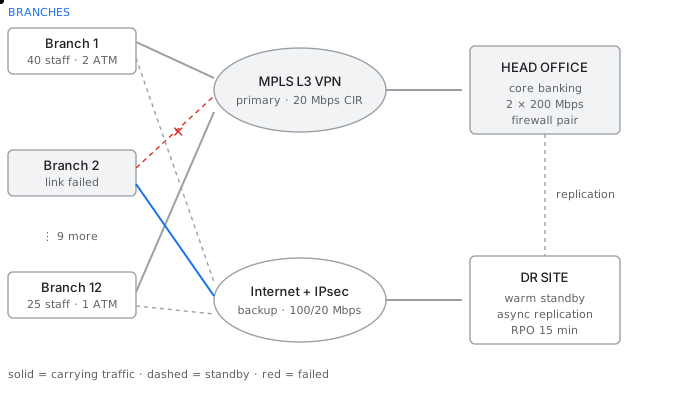
Hub-and-spoke WAN with MPLS primary and internet backup — branch 2's MPLS link is down and its traffic has wrapped to the backup path
(a)5 marks
Choose a WAN topology and justify it against a full mesh, given that all applications are hosted at the head office.
සිංහලෙන්: සියලුම යෙදුම් ප්රධාන කාර්යාලයේ සත්කාරකත්වය ලබා දී ඇති බැවින්, WAN ස්ථලකයක් තෝරා එය සම්පූර්ණ දැලකට එරෙහිව සාධාරණීකරණය කරන්න.
Model answerආදර්ශ පිළිතුර
The correct topology is hub and spoke, with the head office as the hub and each branch as a spoke, and a second hub at the disaster recovery site.
සිංහලෙන්: නිවැරදි ස්ථල විද්යාව කේන්ද්රස්ථානය සහ කථනය වේ, ප්රධාන කාර්යාලය කේන්ද්රස්ථානය ලෙසත්, සෑම ශාඛාවක්ම කථනයක් ලෙසත්, සහ ආපදා ප්රතිසාධන ස්ථානයේ දෙවන කේන්ද්රස්ථානයක් ලෙසත් ඇත.
A full mesh between thirteen sites would need n times n minus one over two links, that is thirteen times twelve over two, which is 78 circuits. Hub and spoke needs twelve, plus the head office and disaster recovery links. The mesh costs six times more and buys nothing here, because no branch ever needs to talk to another branch: every transaction terminates at the head office.
සිංහලෙන්: අඩවි දහතුනක් අතර සම්පූර්ණ දැලකට n වාරයක් n ලින්ක් දෙකකින් එකක් අඩුවෙන් අවශ්ය වේ, එනම් දෙකට වඩා දහතුන් ගුණයක් දොළහක්, එනම් පරිපථ 78කි. හබ් සහ කථනයට දොළහක් අවශ්ය වන අතර ප්රධාන කාර්යාලය සහ ආපදා ප්රතිසාධන සබැඳි ද අවශ්ය වේ. දැලෙහි මිල හය ගුණයකින් වැඩි වන අතර මෙහි කිසිවක් මිලට නොගනී, මන්ද කිසිදු ශාඛාවකට වෙනත් ශාඛාවක් සමඟ කතා කිරීමට අවශ්ය නොවන බැවිනි: සෑම ගනුදෙනුවක්ම ප්රධාන කාර්යාලයේදී අවසන් වේ.
A mesh is the right answer only when traffic is genuinely branch to branch, for example a voice network where staff call each other directly. Here the voice call also terminates on the head office call server, so even voice follows the hub and spoke pattern.
සිංහලෙන්: දැලක් යනු නිවැරදි පිළිතුර වන්නේ ගමනාගමනය අව්යාජ ලෙස ශාඛාවෙන් ශාඛාවක් වන විට පමණි, උදාහරණයක් ලෙස කාර්ය මණ්ඩලය එකිනෙකාට සෘජුව අමතන හඬ ජාලයක්. මෙහිදී හඬ ඇමතුම ප්රධාන කාර්යාල ඇමතුම් සේවාදායකය මතද අවසන් වේ, එබැවින් හඬ පවා හබ් සහ කථන රටාව අනුගමනය කරයි.
The one weakness of hub and spoke is that the hub is a single point of failure for the whole bank, which is exactly why the design places a second hub at the disaster recovery site and gives every branch a path to both.
සිංහලෙන්: හබ් සහ කථනයේ ඇති එක් දුර්වලතාවයක් නම්, කේන්ද්රය මුළු බැංකුවටම අසාර්ථක වීමේ තනි ලක්ෂ්යයක් වීමයි, එම නිසා සැලසුම ආපදා ප්රතිසාධන අඩවියේ දෙවන කේන්ද්රයක් තබා සෑම ශාඛාවකටම මාර්ගයක් ලබා දෙයි.
(b)6 marks
Produce an addressing plan from the block 10.20.0.0/16 that lets the head office carry one summary route per region rather than twelve host routes, and keeps card traffic separable.
සිංහලෙන්: ධාරක මාර්ග දොළහකට වඩා කලාපයකට එක් සාරාංශ මාර්ගයක්රැගෙන යාමට ප්රධාන කාර්යාලයට ඉඩ සලසන 10.20.0.0/16 වාරණයෙන් ලිපින සැලැස්මක් නිෂ්පාදනය කරන්න, සහ කාඩ්පත් ගමනාගමනය වෙන් කළ හැකි ලෙස තබා ගන්න.
Sizing one branch
per branch:
   staff data      40 users  + 50% growth = 60   -> /26   64 addresses
   voice            6 phones + growth     = 30   -> /27   32 addresses
   card / ATM       2 ATMs + card readers = 12   -> /28   16 addresses
   branch infra     switches, AP, router  = 12   -> /28   16 addresses
                                          total = 128     -> one /25 per branch
Allocating regions so that one route describes each
10.20.0.0/16  ->  256 blocks of /24, or 512 of /25

  region North   branches 1-4    10.20.0.0   - 10.20.1.255   summary 10.20.0.0/23
  region Central branches 5-8    10.20.2.0   - 10.20.3.255   summary 10.20.2.0/23
  region South   branches 9-12   10.20.4.0   - 10.20.5.255   summary 10.20.4.0/23

  inside region North:
     branch 1   10.20.0.0/25     staff 10.20.0.0/26   voice .64/27
                                 card  .96/28         infra .112/28
     branch 2   10.20.0.128/25
     branch 3   10.20.1.0/25
     branch 4   10.20.1.128/25

  head office    10.20.16.0/20   DR site   10.20.32.0/20
  WAN /30 links  10.20.255.0/24

head office routing table: 3 summary routes, not 12 branch routes
Model answerආදර්ශ පිළිතුර
Branches are grouped into three regions of four, and each region is given a contiguous slash 23. Because every branch inside a region is allocated in order from that slash 23, the head office can carry one summary route per region instead of twelve separate routes, and adding a thirteenth branch changes nothing outside its own region.
සිංහලෙන්: ශාඛා හතරේ කලාප තුනකට කාණ්ඩගත කර ඇති අතර, සෑම කලාපයකටම අඛණ්ඩ කප්පාදුවක් 23 ලබා දී ඇත. කලාපයක් තුළ ඇති සෑම ශාඛාවක්ම එම ස්ලෑෂ් 23 සිට අනුපිළිවෙලට වෙන් කර ඇති නිසා, ප්රධාන කාර්යාලයට වෙනම මාර්ග දොළහක් වෙනුවට කලාපයකට එක් සාරාංශ මාර්ගයක් ගෙන යා හැකි අතර, දහතුන්වන ශාඛාවක් එකතු කිරීමෙන් එහි කලාපයෙන් පිටත කිසිවක් වෙනස් නොවේ.
Card traffic is separable because it has its own slash 28 inside every branch, and because those slash 28 blocks all sit at the same offset, a single firewall rule of the form 10.20.0.96 through 10.20.0.111 repeated per branch, or more practically a dedicated VLAN carried end to end, can describe card traffic without listing devices.
සිංහලෙන්: සෑම ශාඛාවක් තුළම එහිම ස්ලැෂ් 28ක් ඇති නිසාත්, එම ස්ලැෂ් 28 බ්ලොක් සියල්ලම එකම ඕෆ්සෙට් එකක පිහිටා ඇති නිසාත් කාඩ්පත් ගමනාගමනය වෙන් කළ හැකිය, එක් ශාඛාවකට නැවත නැවතත් 10.20.0.96 සිට 10.20.0.111 දක්වා ආකෘති පත්රයේ තනි ෆයර්වෝල්රීතියක් හෝ වඩාත් ප්රායෝගිකව ට්රැෆික් ලයිස්තුවකින් තොරව ගෙන යන විශේෂිත VLAN උපාංග විස්තර කළ හැකිය.
The practical test of an addressing plan is whether a new branch can be added without editing any existing rule. Here it can, because the space was structured before it was handed out.
සිංහලෙන්: ආමන්ත්රණ සැලැස්මක ප්රායෝගික පරීක්ෂණය වන්නේ පවතින කිසිදු රීතියක් සංස්කරණය නොකර නව ශාඛාවක් එක් කළ හැකිද යන්නයි. එය ලබා දීමට පෙර අවකාශය ව්යුහගත වූ නිසා මෙන්න එය කළ හැකිය.
(c)6 marks
Size the branch circuit. Show the voice calculation in full and state the committed rate you would order.
සිංහලෙන්: ශාඛා පරිපථයේ ප්රමාණය. හඬ ගණනය සම්පූර්ණයෙන් පෙන්වන්න සහ ඔබ ඇණවුම් කරන කැපවූ ගාස්තුව සඳහන් කරන්න.
Voice first, because it is the only hard number
G.711 codec payload           64 kbps
packetisation                 20 ms per packet -> 50 packets per second
payload per packet            64000 / 50 / 8 = 160 bytes
headers  RTP 12 + UDP 8 + IP 20            =  40 bytes
                                     subtotal 200 bytes on the wire per packet
Ethernet / MPLS framing add ~18 bytes      = 218 bytes

per call = 218 x 8 x 50 = 87 200 bps = 87.2 kbps
6 concurrent calls       = 523.2 kbps    -> reserve 600 kbps
Then the data, then the order
core banking   40 users x 0.2 Mbps x 0.7 concurrency = 5.6 Mbps
ATM            2 x 0.05                              = 0.1 Mbps
voice reserve                                        = 0.6 Mbps
                                              subtotal 6.3 Mbps busy hour

headroom for burst and growth, x 1.5                 = 9.5 Mbps
CCTV and updates run 22:00-05:00, outside the busy hour -> not added

order 10 Mbps CIR on the MPLS circuit
backup: ordinary business broadband, 100 down / 20 up, IPsec over it
  -> on failover the branch still has 20 Mbps up, more than the 10 Mbps primary,
     but without a bandwidth guarantee, which is the accepted degradation
Model answerආදර්ශ පිළිතුර
The voice calculation is the part students usually get wrong, because the codec rate of 64 kbps is only the payload. Once RTP, UDP, IP and layer two framing are added, a single G.711 call actually occupies about 87 kbps, which is 36 percent more than the codec figure.
සිංහලෙන්: කටහඬ ගණනය කිරීම සාමාන්යයෙන් සිසුන්ට වැරදී යන කොටසයි, මන්ද 64 kbps කෝඩෙක් අනුපාතය ගෙවීම පමණක් වන බැවිනි. RTP, UDP, IP සහ ස්ථර දෙක රාමු එකතු කළ පසු, තනි G.711 ඇමතුමක් ඇත්ත වශයෙන්ම 87 kbps පමණ ගනී, එය කෝඩෙක්රූපයට වඩා සියයට 36ක් වැඩිය.
Note that CCTV upload and software updates are deliberately excluded from the busy hour figure. They are large but they are scheduled outside working hours, so sizing the circuit for them would mean paying all year for capacity used at three in the morning. Instead they are shaped into the overnight window.
සිංහලෙන්: CCTV උඩුගත කිරීම් සහ මෘදුකාංග යාවත්කාලීන කිරීම් කාර්යබහුල පැය සංඛ්යාවෙන් හිතාමතාම බැහැර කර ඇති බව සලකන්න. ඒවා විශාල නමුත් ඒවා වැඩ කරන වේලාවෙන් පිටත සැලසුම් කර ඇත, එබැවින් ඒවා සඳහා පරිපථය ප්රමාණය කිරීම යනු උදේ තුනට භාවිතා කරන ධාරිතාව සඳහා වසර පුරා ගෙවීමයි. ඒ වෙනුවට ඒවා එක රැයකින් ජනේලයට හැඩගස්වා ඇත.
(d)4 marks
Calculate the yearly downtime of a branch with a single circuit at 99.5 percent, and with the dual circuit design, and state what the second circuit is really buying.
සිංහලෙන්: තනි පරිපථයක් සහිත ශාඛාවක වාර්ෂික අක්රීය කාලය සියයට 99.5 කින් සහ ද්විත්ව පරිපථ සැලසුම සමඟ ගණනය කර, දෙවන පරිපථය සැබවින්ම මිල දී ගන්නේ කුමක් දැයි සඳහන් කරන්න.
Working
minutes per year = 525 600

single MPLS circuit, 99.5 %
  unavailability 0.005  ->  2628 minutes = 43.8 hours per year

MPLS 99.5 % and broadband 99.0 % in parallel
  A = 1 - (0.005 x 0.010) = 1 - 0.00005 = 99.995 %
  downtime = 0.00005 x 525 600 = 26.3 minutes per year

improvement factor = 2628 / 26.3 = 100x

but the branch router is now the single point of failure:
  router at 99.9 %  ->  525 minutes = 8.8 hours per year
  combined = 0.99995 x 0.999 = 99.895 %  ->  552 minutes = 9.2 hours
Model answerආදර්ශ පිළිතුර
The second circuit takes the circuit related downtime from nearly 44 hours a year to about 26 minutes, a hundredfold improvement, and it costs a fraction of the primary because it is ordinary broadband rather than a guaranteed circuit.
සිංහලෙන්: දෙවන පරිපථය වසරකට පැය 44කට ආසන්න කාලයක සිට මිනිත්තු 26ක් දක්වා පරිපථය ආශ්රිත අක්රීය කාලය සිය ගුණයකින් වැඩි දියුණු කරන අතර එය සහතික කළ පරිපථයකට වඩා සාමාන්ය බ්රෝඩ්බෑන්ඩ් බැවින් ප්රාථමිකයේ කොටසක් වැය වේ.
The last block is the part worth arguing in an exam. Once both circuits land on the same branch router, that router dominates the arithmetic: the combined figure is 9.2 hours a year, and almost all of it is the router, not the circuits. The next pound is therefore better spent on a second router at the branch than on a third circuit. Redundancy is only worth buying at the current weakest link.
සිංහලෙන්: අවසාන කොටස විභාගයකදී තර්ක කිරීමට වටින කොටසයි. පරිපථ දෙකම එකම ශාඛා රවුටරය මත ගොඩ බැස්ස වූ පසු, එම රවුටරය අංක ගණිතය ආධිපත්යය දරයි: ඒකාබද්ධ රූපය වසරකට පැය 9.2 ක් වන අතර, එය සියල්ලම පාහේ රවුටරය මිස පරිපථ නොවේ. එබැවින් ඊළඟ පවුම තෙවන පරිපථයකට වඩා ශාඛාවේ දෙවන රවුටරය මත වියදම් කිරීම වඩා හොඳය. අතිරික්තය වත්මන් දුර්වලම සබැඳියෙන් පමණක් මිලදී ගැනීම වටී.
(e)4 marks
Design the quality of service treatment at the branch router, and explain why it matters only in one direction.
සිංහලෙන්: ශාඛා රවුටරයේ සේවා ප්රතිකාරයේ ගුණාත්මකභාවය සැලසුම් කරන්න, සහ එය එක් දිශාවකට පමණක් වැදගත් වන්නේ මන්දැයි පැහැදිලි කරන්න.
Model answerආදර්ශ පිළිතුර
Four classes are enough. Voice goes into a strict priority queue with the 600 kbps reservation calculated above and a policer so that a fault cannot let voice starve everything else. Card and cash machine traffic goes into a guaranteed bandwidth class of about 10 percent. Core banking terminal traffic goes into a guaranteed class of about 50 percent. Everything else, meaning updates, CCTV and web browsing, goes into a best effort class that may use whatever is left.
සිංහලෙන්: පන්ති හතරක් ප්රමාණවත්ය. ඉහත ගණනය කර ඇති 600 kbps වෙන් කිරීම සහ පොලිස් නිලධාරියෙකු සමඟ කටහඬ දැඩි ප්රමුඛතා පෝලිමකට යයි. කාඩ්පත් සහ මුදල් යන්ත්ර ගමනාගමනය සියයට 10ක පමණ සහතික කළ කලාප පළල පන්තියකට යයි. මූලික බැංකු පර්යන්ත ගමනාගමනය සියයට 50 ක පමණ සහතික කළ පන්තියකට යයි. යාවත්කාලීන, CCTV සහ වෙබ් බ්රවුසින් යන අර්ථය ඇති අනෙක් සියල්ල, ඉතිරිව ඇති ඕනෑම දෙයක් භාවිතා කළ හැකි හොඳම උත්සාහ පන්තියකට යයි.
Quality of service only does anything at a point where a queue can form, and a queue forms only where a fast link feeds a slow one. At the branch that point is the LAN to WAN direction, where a gigabit switch feeds a 10 Mbps circuit, so the branch router must shape and queue outbound.
සිංහලෙන්: සේවාවේ ගුණාත්මකභාවය ඕනෑම දෙයක් කරන්නේ පෝලිමක් සෑදිය හැකි ස්ථානයක පමණි, සහ පෝලිමක් සෑදෙන්නේ වේගවත් සබැඳියක් මන්දගාමී එකක් පෝෂණය කරන විට පමණි. ශාඛාවේ එම ලක්ෂ්යය LAN සිට WAN දක්වා වන දිශාව වන අතර එහිදී ගිගාබිට් ස්විචයක් 10 Mbps පරිපථයක් පෝෂණය කරයි, එබැවින් ශාඛා රවුටරය හැඩගස්වා පිටතට යන පෝලිම් විය යුතුය.
In the inbound direction the branch cannot help itself, because by the time a packet has arrived over the circuit the bandwidth has already been spent. Inbound priority must therefore be applied at the head office, on its side of the same circuit, which is why quality of service on a WAN is always configured as a matched pair at both ends.
සිංහලෙන්: ඇතුල් වන දිශාවට ශාඛාවට උදව් කළ නොහැක, මන්ද පරිපථය හරහා පැකට්ටුවක් පැමිණෙන විට කලාප පළල දැනටමත් වැය වී ඇත. එම නිසා ප්රධාන කාර්යාලයේ ප්රමුඛතාවය එකම පරිපථයේ පැත්තේ යෙදිය යුතුය, එම නිසා WAN එකක සේවාවේ ගුණාත්මක භාවය සෑම විටම දෙපැත්තටම ගැලපෙන යුගලයක් ලෙස වින්යාස කර ඇත.
Case 2 · A teaching hospital campus
අවස්ථාව 2 · ශික්ෂණ රෝහල් මණ්ඩපයක්
Design the campus network for a hospital: life-critical equipment, medical devices that cannot be patched, radiology images measured in gigabytes, and public wi-fi in the same building.රෝහලක් සඳහා කැම්පස් ජාලය සැලසුම් කරන්න: ජීවිතයට අත්යවශ්ය උපකරණ, පැච් කළ නොහැකි වෛද්ය උපකරණ, ගිගාබයිට් වලින් මනිනු ලබන විකිරණ රූප, සහ එකම ගොඩනැගිල්ලේ පොදු wi-fi.
A teaching hospital occupies four connected buildings. It has 40 intensive care and theatre beds, roughly 900 networked medical devices such as infusion pumps and patient monitors, a radiology department producing CT and MRI studies, 1200 clinical staff using the electronic medical record, an administration department handling billing, and public wi-fi for patients and visitors. Many medical devices run software that the manufacturer will not allow to be patched, and several still use unencrypted protocols.
සිංහලෙන්: ශික්ෂණ රෝහලක් සම්බන්ධිත ගොඩනැගිලි හතරකින් සමන්විත වේ. එහි දැඩි සත්කාර සහ රංග ඇඳන් 40 ක්, ඉන්ෆියුෂන් පොම්ප සහ රෝගී නිරීක්ෂක වැනි ජාලගත වෛද්ය උපකරණ 900 ක්, CT සහ MRI අධ්යයන නිපදවන විකිරණ අංශයක්, විද්යුත් වෛද්ය වාර්තාව භාවිතා කරන සායනික කාර්ය මණ්ඩලය 1200 ක්, බිල්පත් හැසිරවීමේ පරිපාලන දෙපාර්තමේන්තුවක් සහ රෝගීන් සහ අමුත්තන් සඳහා පොදු wi-fi ඇත. බොහෝ වෛද්ය උපාංග නිෂ්පාදකයා විසින් පැච් කිරීමට ඉඩ නොදෙන මෘදුකාංග ක්රියාත්මක කරන අතර කිහිපයක් තවමත් සංකේතනය නොකළ ප්රොටෝකෝල භාවිතා කරයි.
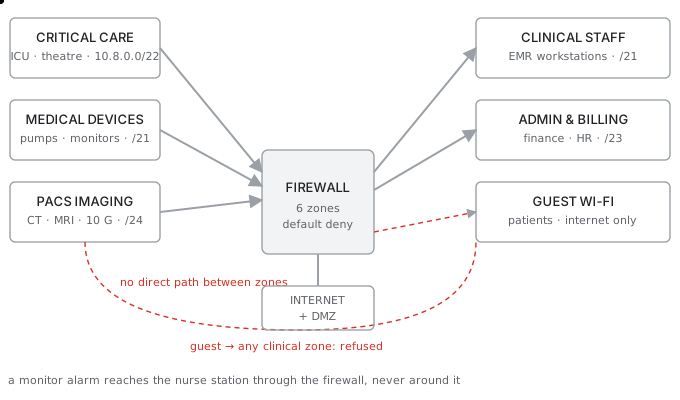
Hospital segmentation — six zones behind one firewall, with the two crossings that are refused
(a)6 marks
Define the security zones and state, for each one, what may open a connection to it. Explain specifically why medical devices are given a zone of their own.
සිංහලෙන්: ආරක්ෂක කලාප නිර්වචනය කර, එක් එක් සඳහා, එයට සම්බන්ධයක් විවෘත කළ හැකි දේ. වෛද්ය උපකරණවලට තමන්ගේම කලාපයක් ලබා දෙන්නේ මන්දැයි විශේෂයෙන් පැහැදිලි කරන්න.
Model answerආදර්ශ පිළිතුර
Six zones are required: critical care, medical devices, radiology and PACS, clinical staff, administration and billing, and guest wi-fi, with the internet and its DMZ outside all of them.
සිංහලෙන්: කලාප හයක් අවශ්ය වේ: විවේචනාත්මක සත්කාර, වෛද්ය උපකරණ, විකිරණවේදය සහ PACS, සායනික කාර්ය මණ්ඩලය, පරිපාලනය සහ බිල්පත්, සහ අමුත්තන් wi-fi, අන්තර්ජාලය සහ එහි DMZ සියල්ලෙන් පිටත.
Critical care and medical devices may be reached from the clinical staff zone and from the monitoring servers, and may themselves reach only the specific application servers they need. They may not reach the internet at all. Radiology may be reached by clinical staff and may send studies to the DMZ for external referral. Clinical staff may reach every clinical zone and the internet. Administration may reach the internet and the billing servers but no clinical zone. Guest wi-fi may reach the internet and absolutely nothing else.
සිංහලෙන්: සායනික කාර්ය මණ්ඩල කලාපයෙන් සහ අධීක්ෂණ සේවාදායකයන්ගෙන් විවේචනාත්මක සත්කාර සහ වෛද්ය උපාංග වෙත ළඟා විය හැකි අතර, ඔවුන්ට අවශ්ය විශේෂිත යෙදුම් සේවාදායකයන් වෙත පමණක් ළඟා විය හැකිය. ඔවුන් අන්තර්ජාලයට කිසිසේත්ම ළඟා නොවිය හැකිය. විකිරණවේදය සායනික කාර්ය මණ්ඩලය විසින් ලබා ගත හැකි අතර බාහිර යොමු කිරීම සඳහා අධ්යයන DMZ වෙත යැවිය හැක. සායනික කාර්ය මණ්ඩලය සෑම සායනික කලාපයකටම සහ අන්තර්ජාලයට ළඟා විය හැකිය. පරිපාලනය අන්තර්ජාලයට සහ බිල්පත් සේවාදායක වෙත ළඟා විය හැකි නමුත් සායනික කලාපයක් නොමැත. අමුත්තන්ගේ wi-fi අන්තර්ජාලයට ළඟා විය හැකි අතර අන් කිසිවක් නැත.
Medical devices get their own zone for a reason that has nothing to do with tidiness. They cannot be patched, because the manufacturer's regulatory certification covers a specific software build, so a known vulnerability may stay open for years. Segmentation is therefore the only available control: if the device cannot be reached from a compromised workstation, the unpatched flaw cannot be used.
සිංහලෙන්: පිළිවෙළට කිසිම සම්බන්ධයක් නැති හේතුවක් නිසා වෛද්ය උපකරණ තමන්ගේම කලාපයක් ලබා ගනී. නිෂ්පාදකයාගේ නියාමන සහතිකය විශේෂිත මෘදුකාංග ගොඩනැගීමක් ආවරණය කරන බැවින් ඒවා පැච් කළ නොහැක, එබැවින් දන්නා අවදානම වසර ගණනාවක් විවෘතව පැවතිය හැකිය. එබැවින් පවතින එකම පාලනය වන්නේ ඛණ්ඩනයයි: සම්මුතියට පත් වැඩපොළකින් උපාංගය වෙත ළඟා විය නොහැකි නම්, නොගැලපෙන දෝෂය භාවිතා කළ නොහැක.
The same reasoning explains why those devices must not reach the internet. A device that cannot be patched must not be allowed to talk to anything that could exploit it, and outbound access is how most compromises actually begin.
සිංහලෙන්: එම උපාංග අන්තර්ජාලයට නොපැමිණිය යුත්තේ මන්දැයි එම තර්කයම පැහැදිලි කරයි. පැච් කළ නොහැකි උපාංගයකට එය සූරාකෑමට හැකි ඕනෑම දෙයක් සමඟ කතා කිරීමට ඉඩ නොදිය යුතු අතර, පිටතට යන ප්රවේශය යනු බොහෝ සම්මුතීන් ඇත්ත වශයෙන්ම ආරම්භ වන ආකාරයයි.
(b)5 marks
The radiology department produces 180 CT and MRI studies a day, averaging 350 MB each, which must reach the PACS archive and be retrievable by any consultant within five seconds. Size the radiology link.
සිංහලෙන්: විකිරණ විද්යා දෙපාර්තමේන්තුව දිනකට CT සහ MRI අධ්යයන 180ක් නිෂ්පාදනය කරයි, සාමාන්යයෙන් 350 MB බැගින් වන අතර, එය PACS ලේඛනාගාරය වෙත ළඟා විය යුතු අතර තත්පර පහක් ඇතුළත ඕනෑම උපදේශකයෙකුට ලබාගත හැක. විකිරණ සම්බන්ධකයේ ප්රමාණය.
Ingest — writing the studies into the archive
180 studies x 350 MB = 63 000 MB = 63 GB per day
working day is not 24 h; imaging runs about 10 hours

average = 63 GB / 10 h = 6.3 GB per hour
        = 6.3 x 8000 Mbit / 3600 s = 14 Mbps average

but studies arrive in bursts as each scan completes:
  a 350 MB study transferred in 30 s = 350 x 8 / 30 = 93 Mbps
  three scanners could finish together  = 280 Mbps peak
Retrieval — the five second requirement is the binding constraint
a consultant opens a 350 MB study and must see it in 5 s

required rate = 350 MB x 8 / 5 s = 560 Mbps for that one user

assume 4 consultants could do this simultaneously at peak
               = 2240 Mbps = 2.24 Gbps

conclusion:
  radiology to core        10 Gbps, not 1 Gbps
  PACS server attachment   2 x 10 Gbps, one to one, not oversubscribed
  consultant workstations  1 Gbps each is enough (560 Mbps < 1 Gbps)

note: the 5 s retrieval, not the daily volume, sized the link.
      14 Mbps average would have suggested a 100 Mbps link — wrong by 100x
(c)5 marks
Design the wireless coverage for a 30 bed ward where every bed has a monitor, nurses carry tablets, and patients use guest wi-fi. State how many access points and why.
සිංහලෙන්: ඇඳන් 30 කින් යුත් වාට්ටුවක් සඳහා රැහැන්රහිත ආවරණය සැලසුම් කරන්න, එහිදී සෑම ඇඳකටම මොනිටරයක් ඇත, හෙදියන් ටැබ්ලට්රැගෙන යයි, සහ රෝගීන් අමුත්තන්ගේ wi-fi භාවිතා කරයි. ප්රවේශ ස්ථාන කීයක් සහ ඇයි දැයි සඳහන් කරන්න.
Working
devices in the ward:
   30 patient monitors            30
   nursing tablets and carts      12
   infusion pumps, 2 per bed      60
   guest devices, 1.5 per patient 45
                          total  147 associated devices

concurrent, not associated:  about 35 % actively transmitting = 52

design rule: 1 access point per 25 concurrent devices on 5 GHz
   52 / 25 = 2.1  ->  3 access points for capacity

coverage check: ward is 40 m x 15 m = 600 m2
   an 802.11ax AP indoors covers about 250 m2 at a usable rate
   600 / 250 = 2.4  ->  3 access points for coverage

both tests agree: 3 APs, each on a different non-overlapping channel
Model answerආදර්ශ පිළිතුර
Both the capacity test and the coverage test give three, which is the reassuring case. When they disagree, capacity wins, because an access point that covers the room but cannot carry the traffic is useless while an access point with a slightly small cell can be helped by turning its power down and adding another.
සිංහලෙන්: ධාරිතා පරීක්ෂණය සහ ආවරණ පරීක්ෂණය යන දෙකෙන්ම තුනක් ලබා දෙයි, එය සහතික කිරීමේ අවස්ථාවයි. ඔවුන් එකඟ නොවන විට, ධාරිතාව ජය ගනී, මන්ද කාමරය ආවරණය වන නමුත් ගමනාගමනය ගෙන යා නොහැකි ප්රවේශ ලක්ෂ්යයක් නිෂ්ඵල වන අතර තරමක් කුඩා කොටුවක් සහිත ප්රවේශ ලක්ෂ්යයක් එහි බලය අඩු කර තවත් එකක් එකතු කිරීමෙන් උපකාර කළ හැකිය.
The essential point is that wi-fi is a shared medium, so the design constraint is contention rather than coverage. One access point per room is the classic wrong answer: it puts three radios in three small rooms all hearing each other, which lowers capacity instead of raising it. Channel planning matters as much as count, which is why the three access points must sit on non overlapping channels.
සිංහලෙන්: අත්යවශ්ය කරුණ නම්, wi-fi යනු හවුල් මාධ්යයක් වන අතර, එබැවින් සැලසුම් සීමාව ආවරණයට වඩා මතභේදයකි. කාමරයකට එක් ප්රවේශ ලක්ෂ්යයක් යනු සම්භාව්ය වැරදි පිළිතුරයි: එය කුඩා කාමර තුනක රේඩියෝ යන්ත්ර තුනක් තබයි, සියල්ල එකිනෙක ඇසෙන අතර, එය ඉහළ නැංවීම වෙනුවට ධාරිතාව අඩු කරයි. නාලිකා සැලසුම් කිරීම ගණන් කරන තරමට වැදගත් වේ, ඒ නිසා ප්රවේශ ස්ථාන තුන අතිච්ඡාදනය නොවන නාලිකා මත සිටිය යුතුය.
The patient monitors must also be on a separate SSID mapped to the medical device VLAN, so that guest traffic and monitor traffic never share a broadcast domain even though they share the radio.
සිංහලෙන්: රෝගීන්ගේ නිරීක්ෂකයින් වෛද්ය උපකරණ VLAN වෙත සිතියම්ගත කරන ලද වෙනම SSID මත ද සිටිය යුතුය, එවිට අමුත්තන්ගේ ගමනාගමනය සහ නිරීක්ෂණ ගමනාගමනය ඔවුන් ගුවන්විදුලිය බෙදා ගත්තද කිසි විටෙකත් විකාශන වසමක් බෙදා නොගනී.
(d)5 marks
The intensive care unit must not lose network connectivity. Design its access layer and calculate the availability improvement.
සිංහලෙන්: දැඩි සත්කාර ඒකකයට ජාල සම්බන්ධතාව අහිමි නොවිය යුතුය. එහි ප්රවේශ ස්තරය සැලසුම් කර ලබා ගත හැකි දියුණුව ගණනය කරන්න.
Working
ordinary ward access layer:
   1 access switch, 1 uplink, 1 power feed
   switch 99.9 % x uplink 99.95 % x power 99.9 %
   = 0.99750  ->  1314 minutes = 21.9 hours per year

intensive care access layer:
   2 access switches, stacked, each bed dual-homed one port to each
   2 uplinks, one to each distribution switch, different risers
   2 power feeds, one on the UPS and generator, one on mains

   switch pair   1 - (0.001)^2   = 0.999999
   uplink pair   1 - (0.0005)^2  = 0.99999975
   power pair    1 - (0.001)^2   = 0.999999
   = 0.99999775  ->  1.2 minutes per year

improvement 1314 / 1.2 = about 1100x
Model answerආදර්ශ පිළිතුර
Every element of the path is duplicated, and crucially the duplicates are separated physically: the two uplinks run up different risers, so that one contractor cutting through one riser cannot take both, and the two power feeds come from different sources.
සිංහලෙන්: මාර්ගයෙහි සෑම මූලද්රව්යයක්ම අනුපිටපත් කර ඇති අතර, තීරණාත්මක ලෙස අනුපිටපත් භෞතිකව වෙන් කර ඇත: උඩුගත කිරීම් දෙක විවිධ රයිසර් දක්වා දිව යයි, එවිට එක්රයිසර් හරහා කපන එක් කොන්ත්රාත්කරුවෙකුට දෙකම ගත නොහැක, සහ බල සංග්රහ දෙක විවිධ ප්රභවයන්ගෙන් පැමිණේ.
This is the difference between redundancy on a diagram and redundancy in a building. Two uplinks that run through the same conduit are one uplink with extra cost, because the failure that matters, someone cutting the conduit, takes both at once. The arithmetic above assumes the two failures are independent, and it is the physical separation that earns the right to that assumption.
සිංහලෙන්: රූප සටහනක අතිරික්තය සහ ගොඩනැගිල්ලක අතිරික්තය අතර වෙනස මෙයයි. එකම වාහකයක් හරහා දිවෙන උඩුගත කිරීම් දෙකක් අමතර පිරිවැයක් සහිත එක් උඩු සබැඳියක් වේ, මන්ද වැදගත් වන අසාර්ථකත්වය, යමෙකු නාලිකාව කැපීම, දෙකම එකවර ගනී. ඉහත අංක ගණිතය අසාර්ථක වීම් දෙක ස්වාධීන යැයි උපකල්පනය කරන අතර, එම උපකල්පනයට අයිතිය ලබා දෙන්නේ භෞතික වෙන්වීමයි.
(e)4 marks
A monitor in the medical device zone needs to alert a nurse station in the clinical staff zone. Explain the path the alert takes and why it must not be made simpler.
සිංහලෙන්: වෛද්ය උපාංග කලාපයේ නිරීක්ෂකයෙකුට සායනික කාර්ය මණ්ඩල කලාපයේ හෙද ස්ථානයක් දැනුවත් කිරීමට අවශ්ය වේ. අනතුරු ඇඟවීමේ මාර්ගය සහ එය සරල නොකළ යුත්තේ මන්දැයි පැහැදිලි කරන්න.
Model answerආදර්ශ පිළිතුර
The alert leaves the monitor on the medical device VLAN, reaches the distribution layer three switch, and is routed to the firewall. The firewall matches a specific rule permitting the monitoring application's port from the device zone to the alerting server in the clinical zone, and only that port. The server then notifies the nurse station, which sits in the clinical staff zone.
සිංහලෙන්: අනතුරු ඇඟවීම වෛද්ය උපාංගය VLAN මත මොනිටරයෙන් පිටවී, බෙදාහැරීමේ ස්ථර තුනේ ස්විචය වෙත ළඟා වන අතර, ගිනි පවුර වෙත යොමු කෙරේ. ෆයර්වෝලය උපාංග කලාපයේ සිට සායනික කලාපයේ අනතුරු ඇඟවීමේ සේවාදායකය වෙත නිරීක්ෂණ යෙදුමේ වරායට අවසර දෙන නිශ්චිත රීතියකට ගැලපේ, සහ එම වරායට පමණි. සේවාදායකයා පසුව සායනික කාර්ය මණ්ඩල කලාපයේ වාඩි වී සිටින හෙද ස්ථානයට දැනුම් දෙයි.
The tempting simplification is to put the monitors and the nurse stations in the same VLAN, so the alert never crosses the firewall and arrives a few milliseconds sooner. That is exactly the wrong trade. It would put an unpatchable device in the same broadcast domain as a general purpose workstation, which is the single arrangement that segmentation exists to prevent.
සිංහලෙන්: පොළඹවන සරල කිරීම නම් මොනිටර සහ හෙද ස්ථාන එකම VLAN තුළ තැබීමයි, එබැවින් අනතුරු ඇඟවීම කිසි විටෙකත් ෆයර්වෝලය හරහා නොයන අතර මිලි තත්පර කිහිපයක් ඉක්මනින් පැමිණේ. එය හරියටම වැරදි වෙළඳාමකි. එය පොදු කාර්ය වැඩපොළක් ලෙස එකම විකාශන වසම තුළ නොගැලපෙන උපාංගයක් තබනු ඇත, එය වැළැක්වීම සඳහා ඛණ්ඩනය පවතින තනි විධිවිධානය වේ.
The added delay is not clinically meaningful. A firewall forwarding a permitted session adds tens of microseconds, while the alarm itself is a human event measured in seconds. Paying microseconds for containment is the correct engineering decision, and being able to explain that trade is the point of the question.
සිංහලෙන්: එකතු කළ ප්රමාදය සායනිකව අර්ථවත් නොවේ. අවසර ලත් සැසියක් යොමු කරන ෆයර්වෝලයක් මයික්රෝ තත්පර දස ගණනක් එකතු කරන අතර එලාමය තත්පර කිහිපයකින් මනිනු ලබන මිනිස් සිදුවීමකි. රඳවා තබා ගැනීම සඳහා මයික්රො තත්පර ගෙවීම නිවැරදි ඉංජිනේරු තීරණය වන අතර වෙළඳාම ප්රශ්නයේ කාරණය බව පැහැදිලි කිරීමට හැකිවීම.
Case 3 · An e-commerce platform before a flash sale
අවස්ථාව 3 · විශේෂ අලෙවියකට පෙර ඊ-වාණිජ්ය වේදිකාවක්
Design and size the data centre network for a retailer whose traffic multiplies by twenty for four hours, once a year.වසරකට වරක් පැය හතරක් සඳහා ගමනාගමනය වැඩිවන සිල්ලර වෙළෙන්දෙකු සඳහා දත්ත මධ්යස්ථාන ජාලය සැලසුම් කර ප්රමාණය කරන්න.
An online retailer normally serves 2000 requests per second. For an annual sale the marketing department expects a twentyfold peak lasting four hours. The platform is three tiers, namely web servers, application servers and a database cluster, and 70 percent of the traffic inside the data centre is server to server rather than to the internet. The business will accept a slower site during the sale but not an unavailable one.
සිංහලෙන්: සබැඳි සිල්ලර වෙළෙන්දෙක් සාමාන්යයෙන් තත්පරයකට ඉල්ලීම් 2000ක් සපයයි. වාර්ෂික අලෙවියක් සඳහා අලෙවිකරණ දෙපාර්තමේන්තුව පැය හතරක් පුරා විසි ගුණයක උපරිමයක් අපේක්ෂා කරයි. වේදිකාව තට්ටු තුනකි, එනම් වෙබ් සේවාදායකයන්, යෙදුම් සේවාදායකයන් සහ දත්ත සමුදා පොකුරක් වන අතර දත්ත මධ්යස්ථානය තුළ ඇති තදබදයෙන් සියයට 70 ක් අන්තර්ජාලයට වඩා සේවාදායකයට වේ. ව්යාපාරය විකිණීම අතරතුර මන්දගාමී අඩවියක් පිළිගන්නා නමුත් ලබා ගත නොහැකි එකක් නොවේ.
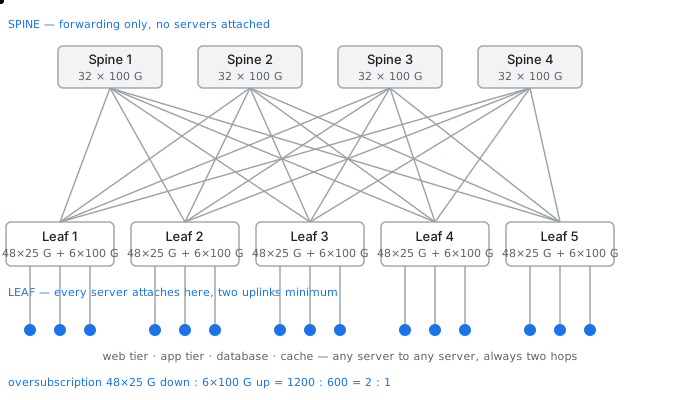
Spine-leaf fabric — every leaf is one hop from every other, and ECMP spreads a flow set across all four spines
(a)6 marks
Choose between a classic three-tier data centre design and a spine-leaf fabric, and support the choice with the oversubscription arithmetic.
සිංහලෙන්: සම්භාව්ය ත්රි-ස්ථර දත්ත මධ්යස්ථාන සැලසුමක් සහ කොඳු ඇට පෙළේ-පත්ර රෙදි අතර තෝරන්න, සහ අධිදායකත්ව අංක ගණිතය සමඟ තේරීමට සහාය වන්න.
Model answerආදර්ශ පිළිතුර
A spine-leaf fabric is the right answer, and the deciding number is the 70 percent of traffic that is server to server, which the industry calls east-west traffic.
සිංහලෙන්: කොඳු ඇට පෙළේ රෙද්දක් නිවැරදි පිළිතුර වන අතර, තීරනාත්මක අංකය වන්නේ සේවාදායක සිට සේවාදායකය දක්වා වන ගමනාගමනයෙන් සියයට 70 ක් වන අතර එය කර්මාන්තය නැගෙනහිර-බටහිර ගමනාගමනය ලෙස හැඳින්වේ.
A classic three-tier design was built for traffic that mostly went in and out of the data centre, so it aggregates upward through distribution to a core. Two servers on different access switches must travel up to the distribution or core layer and back down, and the number of hops depends on where the two servers happen to sit. That variability is fatal when 70 percent of traffic takes that path.
සිංහලෙන්: බොහෝ දුරට දත්ත මධ්යස්ථානය තුළට සහ ඉන් පිටතට යන ගමනාගමනය සඳහා සම්භාව්ය තට්ටු තුනේ සැලසුමක් ගොඩනගා ඇත, එබැවින් එය හරයකට බෙදා හැරීම හරහා ඉහළට එකතු වේ. විවිධ ප්රවේශ ස්විචවල ඇති සේවාදායකයන් දෙකක් බෙදා හැරීම හෝ මූලික ස්ථරය දක්වා ගමන් කළ යුතු අතර ආපසු පහළට ගමන් කළ යුතු අතර, සර්වර් දෙක වාඩි වී සිටින ස්ථානය මත හොප් ගණන රඳා පවතී. ගමනාගමනයෙන් සියයට 70 ක් එම මාර්ගයේ ගමන් කරන විට එම විචල්යතාවය මාරාන්තික වේ.
In a spine-leaf fabric every leaf connects to every spine and no leaf connects to another leaf. Any server is therefore exactly two hops from any other server, leaf to spine to leaf, and the latency between any pair is the same and predictable. Equal cost multipath spreads flows across all the spines, so the fabric bandwidth grows simply by adding another spine.
සිංහලෙන්: කොඳු ඇට පෙළේ රෙදි කැබැල්ලක සෑම කොළයක්ම සෑම කොඳු ඇට පෙළකටම සම්බන්ධ වන අතර කිසිදු කොළයක් වෙනත් කොළයකට සම්බන්ධ නොවේ. එබැවින් ඕනෑම සේවාදායකයක් වෙනත් ඕනෑම සේවාදායකයකින් හරියටම හොප් දෙකක් වන අතර, කොළ සිට කොඳු ඇට පෙළට පත්රය දක්වා වන අතර ඕනෑම යුගලයක් අතර ප්රමාදය සමාන වන අතර පුරෝකථනය කළ හැකිය. සමාන පිරිවැය බහුපාර්ශ්වික පැතිරීම් සියලු කටු හරහා ගලා යයි, එබැවින්රෙදි කලාප පළල තවත් කොඳු ඇට පෙළක් එකතු කිරීමෙන් සරලව වර්ධනය වේ.
The cost of the fabric is a great deal of cabling, and it only pays for itself when east-west traffic dominates. For a network that is mostly clients reaching one application, three tiers remains the cheaper and correct answer.
සිංහලෙන්: රෙදිපිළිවල පිරිවැය විශාල කේබල් එකක් වන අතර, එය ගෙවනු ලබන්නේ නැගෙනහිර-බටහිර ගමනාගමනය ආධිපත්යය දරන විට පමණි. බොහෝ විට එක් යෙදුමකට ළඟා වන සේවාදායකයින් වන ජාලයක් සඳහා, ස්ථර තුනක් ලාභදායී සහ නිවැරදි පිළිතුර ලෙස පවතී.
Oversubscription of one leaf
leaf switch: 48 server ports at 25 G, 6 uplinks at 100 G

downlink capacity = 48 x 25  = 1200 Gbps
uplink capacity   =  6 x 100 =  600 Gbps

oversubscription = 1200 : 600 = 2 : 1

a 3:1 ratio is common; 2:1 is chosen here because east-west is 70 %

fabric capacity with 4 spines and 5 leaves:
   each leaf contributes 600 Gbps upward
   5 x 600 = 3000 Gbps of fabric bandwidth, shared by any pair
(b)6 marks
Size the internet edge and the load balancer for the sale. Each request averages 180 kB of response and holds its connection for 1.2 seconds.
සිංහලෙන්: විකිණීම සඳහා අන්තර්ජාල දාරය සහ පැටවුම් ශේෂය ප්රමාණය කරන්න. සෑම ඉල්ලීමක්ම සාමාන්යයෙන් 180 kB ප්රතිචාරයක් වන අතර එහි සම්බන්ධතාවය තත්පර 1.2ක් සඳහා රඳවා තබා ගනී.
Bandwidth
normal   2 000 requests per second
peak     2 000 x 20 = 40 000 requests per second

bandwidth = 40 000 x 180 kB x 8
          = 40 000 x 1 440 000 bits
          = 57 600 000 000 bps = 57.6 Gbps

CDN offloads static content, historically 80 % of bytes:
   origin bandwidth = 57.6 x 0.20 = 11.5 Gbps

order 2 x 10 Gbps internet circuits from different providers
   -> 20 Gbps capacity, survives one provider failing, 58 % loaded at peak
Concurrent connections at the load balancer
Little's law:  L = arrival rate x time in system

concurrent connections = 40 000 per second x 1.2 s = 48 000

add TIME_WAIT sockets, browsers opening 6 parallel connections,
and health checks; design for 3x headroom = 150 000 concurrent

load balancer must therefore support:
   150 000 concurrent connections
    40 000 new connections per second  <- the harder number
   TLS termination at 40 000 handshakes per second

TLS is the real constraint: a full RSA handshake is far more expensive
than a resumed one, so session resumption must be enabled or the
handshake rate alone will exhaust the appliance
(c)5 marks
The database cluster cannot be scaled out in four hours. Design around that constraint.
සිංහලෙන්: දත්ත සමුදා පොකුර පැය හතරකින් පරිමාණය කළ නොහැක. එම සීමාව වටා නිර්මාණය කරන්න.
Model answerආදර්ශ පිළිතුර
The database is the one tier that cannot absorb a twentyfold increase, because adding a replica requires copying and warming the data, which takes far longer than the sale lasts. The design must therefore keep load off it rather than trying to grow it.
සිංහලෙන්: දත්ත සමුදාය යනු විසි ගුණයක වැඩිවීමක් අවශෝෂණය කරගත නොහැකි එක් ස්ථරයකි, මන්ද අනුරුවක් එකතු කිරීම සඳහා දත්ත පිටපත් කිරීම සහ උණුසුම් කිරීම අවශ්ය වන අතර, එය විකිණීමට වඩා බොහෝ කාලයක් ගතවේ. එබැවින් නිර්මාණය එය වර්ධනය කිරීමට උත්සාහ කරනවාට වඩා බර පැටවිය යුතුය.
Three mechanisms do that. A cache tier in front of the database holds product and price data, which is read constantly and changes rarely, so a very high proportion of reads never reach the database at all. Read replicas take reporting and browse queries, leaving the primary for writes. And a queue in front of the order path turns a burst of writes into a steady stream the database can actually sustain, at the cost of the customer seeing a confirmation a second or two later.
සිංහලෙන්: යාන්ත්රණ තුනක් එය සිදු කරයි. දත්ත සමුදාය ඉදිරිපිට ඇති හැඹිලි ස්ථරයක් නිෂ්පාදන සහ මිල දත්ත රඳවා තබා ගනී, එය නිරන්තරයෙන් කියවන අතර කලාතුරකින් වෙනස් වේ, එබැවින් කියවීම්වල ඉතා ඉහළ ප්රතිශතයක් කිසි විටෙකත් දත්ත සමුදායට ළඟා නොවේ. පිටපත් කියවීම වාර්තා කිරීම සහ විමසුම් බ්රවුස් කිරීම, ලිවීම් සඳහා ප්රාථමිකය තබයි. ඇණවුම් මාර්ගය ඉදිරිපිට ඇති පෝලිමක්, තත්පරයකට හෝ දෙකකට පසුව තහවුරු කිරීමක් දකින පාරිභෝගිකයාගේ වියදමින්, දත්ත සමුදායට සැබවින්ම පවත්වා ගත හැකි ස්ථාවර ප්රවාහයක් බවට පත් කරයි.
The network consequence is that the cache tier and the database now carry the heaviest east-west traffic in the building, so they must sit on leaves with one to one uplinks rather than the two to one used for web servers, and their servers must be dual homed.
සිංහලෙන්: ජාල ප්රතිවිපාකය නම් හැඹිලි ස්ථරය සහ දත්ත සමුදාය දැන් ගොඩනැගිල්ලේ ඇති දැඩිම නැගෙනහිර-බටහිර ගමනාගමනය රැගෙන යාමයි, එබැවින් ඔවුන් වෙබ් සේවාදායකයන් සඳහා භාවිතා කරන දෙකට එකකට වඩා එකකින් එකකට උඩුගත කිරීම් සහිත කොළ මත වාඩි විය යුතු අතර ඒවායේ සේවාදායකයන් ද්විත්ව නිවාස විය යුතුය.
It is worth stating plainly that this is an application architecture answer to a capacity question. The network cannot fix a database that cannot scale; it can only be designed so that it is not the thing that breaks first.
සිංහලෙන්: මෙය ධාරිතා ප්රශ්නයකට යෙදුම් ගෘහ නිර්මාණ පිළිතුරක් බව පැහැදිලිව පැවසීම වටී. ජාලයට පරිමාණය කළ නොහැකි දත්ත සමුදායක් සවි කළ නොහැක; එය නිර්මාණය කළ හැක්කේ එය මුලින් කැඩී නොයන ලෙස පමණි.
(d)4 marks
Analyse the failure domains. If one spine fails during the sale, what happens, and what if one leaf fails?
සිංහලෙන්: අසාර්ථක වසම් විශ්ලේෂණය කරන්න. විකිණීමේදී එක් කොඳු ඇට පෙළක් අසමත් වුවහොත්, කුමක් සිදුවේද, සහ එක් කොළයක් අසමත් වුවහොත් කුමක් කළ යුතුද?
Working
spine failure, 1 of 4
   fabric bandwidth 3000 -> 2250 Gbps, a 25 % loss
   ECMP re-hashes flows across the surviving 3 spines
   no server loses connectivity; nothing is isolated
   -> degraded, not down. This is why 4 spines rather than 2.

leaf failure, 1 of 5
   every server attached only to that leaf is isolated
   -> that is why each server is dual homed to two leaves
   with dual homing: lose 50 % of that rack's bandwidth, 0 % of its servers

rule: a spine failure costs bandwidth, a leaf failure costs servers.
      spread a service across leaves, never concentrate it on one.
Model answerආදර්ශ පිළිතුර
The design consequence of that last line is that the web tier must not be racked together. Sixteen web servers on one leaf look tidy and are a single failure away from losing the whole tier; four servers on each of four leaves survive any single leaf failure with 75 percent of capacity intact.
සිංහලෙන්: එම අවසාන පේළියේ සැලසුම් ප්රතිවිපාකය නම් වෙබ් ස්ථරය එකට රැක් නොකළ යුතුය. එක් පත්රයක් මත ඇති වෙබ් සේවාදායකයන් 16ක් පිළිවෙලට පෙනෙන අතර සම්පූර්ණ ස්ථරයම අහිමි වීමෙන් එක අසාර්ථකත්වයකින් යුක්ත වේ; එක් එක් පත්ර හතරක ඇති සර්වර් හතරක් ඕනෑම පත්ර අසමත් වීමකින් 75% ක ධාරිතාවයකින් නොනැසී පවතී.
This is the same reasoning as the hospital risers. Redundancy is only real when the redundant halves fail independently, and that is a physical placement decision, not a configuration one.
සිංහලෙන්: ඉස්පිරිතාල නැගලා යන තර්කයම තමයි මේක. අතිරික්ත අර්ධයන් ස්වාධීනව අසමත් වූ විට පමණක් අතිරික්තය සැබෑ වන අතර එය භෞතික ස්ථානගත කිරීමේ තීරණයක් මිස වින්යාස කිරීමක් නොවේ.
(e)4 marks
The sale attracts a volumetric denial of service attack of 40 Gbps. Explain why the on-site firewall cannot handle it and what must.
සිංහලෙන්: විකිණීම 40 Gbps ප්රහාරයේ පරිමාමිතික ප්රතික්ෂේප කිරීමක් ආකර්ෂණය කරයි. වෙබ් අඩවියේ ෆයර්වෝලයට එය හැසිරවිය නොහැක්කේ ඇයි සහ කුමක් විය යුතුද යන්න පැහැදිලි කරන්න.
Model answerආදර්ශ පිළිතුර
The site has 20 Gbps of internet capacity. A 40 Gbps attack fills those circuits completely before a single packet reaches the firewall, so the firewall's own capacity is irrelevant. The congestion happens upstream, on the provider's side of the link, and nothing installed inside the building can relieve it.
සිංහලෙන්: වෙබ් අඩවියේ අන්තර්ජාල ධාරිතාව 20 Gbps ඇත. 40 Gbps ප්රහාරයක් තනි පැකට්ටුවක් ෆයර්වෝලයට පැමිණීමට පෙර එම පරිපථ සම්පූර්ණයෙන්ම පුරවයි, එබැවින් ෆයර්වෝලයේම ධාරිතාව අදාළ නොවේ. ලින්ක් එකේ සැපයුම්කරුගේ පැත්තේ උඩුගං බලා තදබදය ඇති වන අතර ගොඩනැගිල්ල තුළ ස්ථාපනය කර ඇති කිසිවකට එය සමනය කළ නොහැක.
Volumetric attacks must therefore be absorbed where there is more capacity than the attack, which means at the provider or at a scrubbing service whose own capacity is measured in terabits. In practice this is arranged in advance: traffic is diverted to the scrubbing centre by a BGP announcement when an attack is detected, cleaned there, and returned over a tunnel.
සිංහලෙන්: එබැවින් ප්රහාරයට වඩා වැඩි ධාරිතාවක් ඇති විට පරිමාමිතික ප්රහාර අවශෝෂණය කළ යුතුය, එනම් සපයන්නා හෝ ටෙරාබිට් වලින් මනිනු ලබන ස්ක්රබ් කිරීමේ සේවාවක ය. ප්රායෝගිකව මෙය කල්තියා සකසනු ලැබේ: ප්රහාරයක් අනාවරණය වූ විට, එහි පිරිසිදු කර, උමගක් හරහා ආපසු එන විට BGP නිවේදනයක් මගින් මාර්ග තදබදය පිරිසිදු කිරීමේ මධ්යස්ථානය වෙත හරවා යවනු ලැබේ.
The on-site firewall remains useful for the attacks it can actually see, meaning application layer floods that arrive at a normal traffic volume but are expensive to serve. The distinction worth stating is that a volumetric attack is a capacity problem solved upstream, while an application layer attack is a logic problem solved locally.
සිංහලෙන්: වෙබ් අඩවියේ ඇති ෆයර්වෝලය ඇත්ත වශයෙන්ම දැකිය හැකි ප්රහාර සඳහා ප්රයෝජනවත් වේ, එනම් සාමාන්ය රථවාහන පරිමාවකට පැමිණෙන නමුත් සේවය කිරීමට මිල අධික වන යෙදුම් ස්ථර ගංවතුරයි. ප්රකාශ කළ යුතු වෙනස නම් පරිමාමිතික ප්රහාරයක් යනු උඩුගං බලා විසඳන ලද ධාරිතා ගැටලුවක් වන අතර යෙදුම් ස්ථර ප්රහාරයක් යනු දේශීයව විසඳන ලද තාර්කික ගැටලුවකි.
Case 4 · Dual-homing a university to two providers
අවස්ථාව 4 · විශ්වවිද්යාලයක් සැපයුම්කරුවන් දෙදෙනෙකුට සම්බන්ධ කිරීම
Design the internet edge for a university that has its own address block and its own autonomous system number, and must survive a provider failure without changing anything by hand.තමන්ගේම ලිපින වාරණ සහ තමන්ගේම ස්වයංක්රීය පද්ධති අංකයක් ඇති විශ්ව විද්යාලයක් සඳහා අන්තර්ජාල දාරය සැලසුම් කරන්න, සහ අතින් කිසිවක් වෙනස් නොකර සැපයුම්කරුගේ අසාර්ථකත්වයකින් බේරී සිටිය යුතුය.
A university has been allocated the provider independent address block 203.0.112.0/22 and the autonomous system number 65100. It buys 1 Gbps of transit from two different providers whose networks do not overlap. It wants outbound traffic to prefer the cheaper provider, inbound traffic to arrive mostly on the same one, and a failure of either provider to be handled automatically within a minute.
සිංහලෙන්: විශ්ව විද්යාලයකට සපයන්නාගේ ස්වාධීන ලිපින වාරණ 203.0.112.0/22 සහ ස්වයංක්රීය පද්ධති අංක 65100 වෙන් කර ඇත. එය ජාලයන් අතිච්ඡාදනය නොවන විවිධ සැපයුම්කරුවන් දෙදෙනෙකුගෙන් සංක්රමණ 1 Gbps මිල දී ගනී. පිටතට යන ගමනාගමනය මිල අඩු සැපයුම්කරුට ප්රිය කිරීම, පැමිණෙන ගමනාගමනය බොහෝ දුරට එකම එකකින් පැමිණීමට සහ සපයන්නාගෙන් එක් අයෙකු මිනිත්තුවක් ඇතුළත ස්වයංක්රීයව හැසිරවීමට අසමත් වීම එයට අවශ්ය වේ.
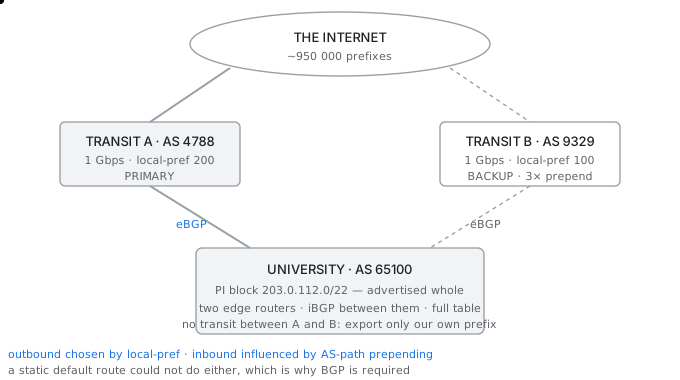
Dual-homed university AS — Transit A carries the traffic, Transit B is prepended and idles until A fails
(a)5 marks
Explain why a default route to each provider is not sufficient, and what specifically BGP provides here.
සිංහලෙන්: එක් එක් සැපයුම්කරු වෙත පෙරනිමි මාර්ගයක් ප්රමාණවත් නොවන්නේ මන්දැයි සහ විශේෂයෙන් BGP මෙහි සපයන දේ පැහැදිලි කරන්න.
Model answerආදර්ශ පිළිතුර
A static default route can send traffic to a provider, but it cannot tell whether that provider still has a path to the destination. If the provider's own upstream fails while the local circuit stays up, the route remains in the table and the university keeps handing packets to a provider that cannot deliver them. The failure is silent, which is the worst kind.
සිංහලෙන්: ස්ථිතික පෙරනිමි මාර්ගයකට සැපයුම්කරුවෙකු වෙත ගමනාගමනය යැවිය හැක, නමුත් එම සැපයුම්කරුට ගමනාන්තය වෙත තවමත් මාර්ගයක් තිබේදැයි පැවසිය නොහැක. දේශීය පරිපථය ක්රියාත්මක වන විට සැපයුම්කරුගේම උඩුගං බලා අසමත් වුවහොත්, මාර්ගය මේසයේ පවතින අතර විශ්ව විද්යාලය විසින් පැකට් ලබා දිය නොහැකි සැපයුම්කරුවෙකුට ලබා දෙයි. අසාර්ථකත්වය නිහඬයි, එය නරකම වර්ගයයි.
BGP fixes that because it is a reachability protocol rather than a link protocol. The provider advertises the prefixes it can actually reach, and withdraws them when it cannot, so the university's router learns about the failure even though its own circuit never went down.
සිංහලෙන්: එය සම්බන්ධක ප්රොටෝකෝලයකට වඩා ළඟා විය හැකි ප්රොටෝකෝලයක් වන නිසා BGP එය නිවැරදි කරයි. සපයන්නා තමාට සැබවින්ම ළඟා විය හැකි උපසර්ග ප්රචාරණය කරයි, සහ නොහැකි වූ විට ඒවා ඉවත් කරයි, එබැවින් විශ්ව විද්යාලයේ රවුටරය එහිම පරිපථය කිසි විටෙකත් ක්රියා විරහිත වුවද අසාර්ථක වීම ගැන දැන ගනී.
BGP also provides the other half of the requirement, which is being reachable. The university must advertise 203.0.112.0/22 to both providers so that the rest of the internet learns two paths back to it. Without that advertisement the block is unreachable no matter how many circuits are bought, because nobody outside knows where to send the traffic.
සිංහලෙන්: BGP විසින් අවශ්යතාවයේ ඉතිරි භාගය ද ලබා දෙන අතර එය ළඟා විය හැකිය. විශ්ව විද්යාලය විසින් සපයන්නන් දෙදෙනාටම 203.0.112.0/22 ප්රචාරණය කළ යුතු අතර එමඟින් අන්තර්ජාලයේ ඉතිරි කොටස් එයට නැවත මාර්ග දෙකක් ඉගෙන ගනී. ඔය ඇඩ්වර්ටයිස්මන්ට් එක නැතුව කොච්චර සර්කිට් ගත්තත් බ්ලොක් එක රිච් වෙන්න බෑ, මොකද ට්රැෆික් එක යවන්න එලියෙ කවුරුත් දන්නෙ නැති නිසා.
Finally, BGP is what makes the address block portable. Because the university owns the block and the autonomous system number, it can change providers without renumbering a single host, which is the whole point of provider independent addressing.
සිංහලෙන්: අවසාන වශයෙන්, BGP යනු ලිපින අවහිර කිරීම අතේ ගෙන යා හැකි බවට පත් කරයි. විශ්ව විද්යාලයට බ්ලොක් එක සහ ස්වයංක්රීය පද්ධති අංකය හිමි නිසා, එයට එක් සත්කාරකයක් නැවත අංකනය නොකර සැපයුම්කරුවන් වෙනස් කළ හැකිය, එය සපයන්නාගේ ස්වාධීන ආමන්ත්රණයේ සමස්ත ලක්ෂ්යය වේ.
(b)6 marks
Design the routing policy so that outbound prefers Transit A and inbound also arrives mostly on Transit A. Name the attribute used in each direction and explain why they are different.
සිංහලෙන්: මාර්ගගත කිරීමේ ප්රතිපත්තිය සැලසුම් කරන්න, එවිට පිටතට යන සංක්රමණ A වලට වැඩි කැමැත්තක් දක්වන අතර පැමිණෙන ඒවා බොහෝ දුරට Transit A මත පැමිණේ. එක් එක් දිශාවට භාවිතා කරන ගුණාංග නම් කර ඒවා වෙනස් වන්නේ මන්දැයි පැහැදිලි කරන්න.
Outbound — entirely under our control
local preference is set on routes we RECEIVE, and it is local to our AS

   routes learned from Transit A   ->  local-pref 200
   routes learned from Transit B   ->  local-pref 100

higher local-pref wins, so every outbound packet leaves via A
if A withdraws a prefix, only B's copy remains and traffic moves there

local-pref is the FIRST tiebreaker in the BGP decision process,
which is why it is the right tool: it overrides AS-path length
Inbound — only influenced, never controlled
we cannot set anything inside other people's routers, so we make
the path through B look worse by making it look longer:

   advertise to Transit A:  203.0.112.0/22  AS-path  65100
   advertise to Transit B:  203.0.112.0/22  AS-path  65100 65100 65100

a distant router comparing the two prefers the shorter path -> comes via A

this is only a preference. A network that peers directly with B,
or whose own local-pref favours B, will still arrive via B,
and there is nothing we can do about that.
Model answerආදර්ශ පිළිතුර
The two directions use different attributes because of where each one is evaluated. Local preference never leaves the autonomous system that sets it, so it is perfect for deciding how our own traffic leaves and useless for influencing anyone else. AS path length does travel with the advertisement, so prepending our own number is the only lever that reaches other people's routers.
සිංහලෙන්: දිශාවන් දෙක එකිනෙකට වෙනස් ගුණාංග භාවිතා කරයි, මන්ද එක් එක් ඒවා ඇගයීමට ලක් කෙරේ. දේශීය මනාපය එය සකසන ස්වයංක්රීය පද්ධතියෙන් කිසිවිටෙක ඉවත් නොවේ, එබැවින් එය අපගේම ගමනාගමනය පිටවන්නේ කෙසේද යන්න තීරණය කිරීම සඳහා පරිපූර්ණ වන අතර වෙනත් අයෙකුට බලපෑම් කිරීම සඳහා නිෂ්ඵල වේ. AS මාර්ගය දිග වෙළඳ දැන්වීම සමඟ ගමන් කරයි, එබැවින් අපගේම අංකය පෙරදැරිව වෙනත් පුද්ගලයින්ගේ රවුටර වෙත ළඟා වන එකම ලීවරය වේ.
The asymmetry is worth stating plainly: outbound routing is a decision, inbound routing is a request. Any design that claims to control inbound traffic precisely is wrong, and the honest goal is to shift the majority.
සිංහලෙන්: අසමමිතිය පැහැදිලිව ප්රකාශ කිරීම වටී: පිටතට යන මාර්ගගත කිරීම තීරණයකි, අභ්යන්තර මාර්ගගත කිරීම ඉල්ලීමකි. පැමිණෙන ගමනාගමනය නිශ්චිතවම පාලනය කරන බව පවසන ඕනෑම සැලසුමක් වැරදි වන අතර අවංක ඉලක්කය වන්නේ බහුතරය මාරු කිරීමයි.
(c)5 marks
Write the address plan for the block, including what is advertised, and explain why the university must not advertise the subnets.
සිංහලෙන්: ප්රචාරණය කර ඇති දේ ඇතුළුව අවහිරය සඳහා ලිපින සැලැස්ම ලියන්න, සහ විශ්වවිද්යාලය උපජාල ප්රචාරණය නොකළ යුත්තේ මන්දැයි පැහැදිලි කරන්න.
Plan for 203.0.112.0/22 — 1024 addresses
  203.0.112.0/24   student and teaching networks   (NAT'd behind this)
  203.0.113.0/24   staff and administration
  203.0.114.0/25   public servers, DMZ
  203.0.114.128/26 research, direct global addressing, no NAT
  203.0.114.192/27 network infrastructure, loopbacks
  203.0.114.224/30 point to point to Transit A
  203.0.114.228/30 point to point to Transit B
  203.0.115.0/24   reserved for growth

advertised to BOTH providers:  203.0.112.0/22   and nothing else
Model answerආදර්ශ පිළිතුර
Only the aggregate is advertised. Advertising the four slash 24 components as well would put three extra routes into the global table for no benefit to anyone, and the global table is a shared resource that every router on the internet must hold in memory.
සිංහලෙන්: ප්රචාරණය කරනු ලබන්නේ එකතුව පමණි. ස්ලැෂ් 24 සංරචක හතර ප්රචාරණය කිරීමෙන් කිසිවෙකුට කිසිදු ප්රයෝජනයක් නොමැතිව ගෝලීය වගුවට අමතර මාර්ග තුනක් ඇතුළත් වන අතර ගෝලීය වගුව අන්තර්ජාලයේ සෑම රවුටරයක්ම මතකයේ තබා ගත යුතු හවුල් සම්පතකි.
There is also a practical reason. Because longest prefix matching always wins, advertising a slash 24 to one provider and the slash 22 to the other would silently force all traffic for that slash 24 through the first provider, defeating the load sharing the design was built for. Deaggregation is a blunt tool that overrides every other policy.
සිංහලෙන්: ප්රායෝගික හේතුවක් ද තිබේ. දිගම උපසර්ගය ගැලපීම සැම විටම ජයග්රහණය කරන බැවින්, එක් සැපයුම්කරුවෙකුට 24 කප්පාදුවක් සහ අනෙකට ස්ලෑෂ් 22 ප්රචාරණය කිරීම පළමු සැපයුම්කරු හරහා එම slash 24 සඳහා සියලු ගමනාගමනය නිශ්ශබ්දව බල කරනු ඇත, නිර්මාණය ගොඩනඟා ඇති බර බෙදාගැනීම පරාජය කරයි. Deaggregation යනු අනෙකුත් සෑම ප්රතිපත්තියක්ම අභිබවා යන මොට මෙවලමකි.
Many providers filter advertisements longer than the allocation anyway, so the extra routes often would not propagate. The correct behaviour is to advertise exactly what was allocated.
සිංහලෙන්: බොහෝ සපයන්නන් කෙසේ හෝ ප්රතිපාදනයට වඩා දිගු දැන්වීම් පෙරහන් කරයි, එබැවින් අමතර මාර්ග බොහෝ විට ප්රචාරණය නොවේ. නිවැරදි හැසිරීම නම් වෙන් කළ දේ හරියටම ප්රචාරය කිරීමයි.
(d)5 marks
Transit A fails at 09:00. Describe what happens, with timings, and calculate the availability of the pair.
සිංහලෙන්: සංක්රමණ A 09:00 ට අසමත් වේ. වේලාවන් සමඟ සිදු වන දේ විස්තර කරන්න, සහ යුගලයේ ඇති බව ගණනය කරන්න.
Failure sequence
t = 0      circuit to Transit A goes down

if the failure is physical (fibre cut):
   t = 0       interface down detected in milliseconds
   t < 1 s     BGP session torn down immediately on interface down

if the failure is logical (provider's upstream fails, circuit stays up):
   t = 0-180 s BGP hold timer, default 180 s, must expire
   -> this is why BFD is configured: detection in 150 ms instead of 180 s

then, either way:
   all routes learned from A are withdrawn from the table
   B's copies, at local-pref 100, become best
   FIB reprogrammed, outbound traffic now leaves via B
   inbound: the internet still has our prepended advertisement via B,
            so return traffic already has a valid path

total with BFD: under 1 second.  Without BFD: up to 3 minutes.
Availability of the pair
each transit service 99.5 %

parallel:  A = 1 - (0.005)^2 = 0.999975
downtime = 0.000025 x 525 600 = 13.1 minutes per year

compare a single provider: 0.005 x 525 600 = 2628 minutes = 43.8 hours

assumption check: the two providers must not share a duct into the campus,
or the 'parallel' calculation is fiction and both fail together.
(e)4 marks
A misconfiguration causes the university to advertise routes learned from Transit A onward to Transit B. Describe the consequence and the filter that prevents it.
සිංහලෙන්: වැරදි වින්යාසයක් නිසා Transit A සිට Transit B දක්වා උගත් මාර්ග ප්රචාරණය කිරීමට විශ්ව විද්යාලය හේතු වේ. ප්රතිවිපාකය සහ එය වළක්වන පෙරහන විස්තර කරන්න.
Model answerආදර්ශ පිළිතුර
The university would be announcing that it can reach the whole internet through itself. Transit B, and then B's other customers, would begin sending transit traffic through the university's 1 Gbps circuits to reach destinations behind Transit A. A campus link built for a few thousand users would be carrying traffic between two providers, and it would saturate within seconds. This is a route leak, and it has taken large parts of the internet offline more than once.
සිංහලෙන්: විශ්ව විද්යාලය නිවේදනය කරන්නේ තමා හරහා මුළු අන්තර්ජාලයටම යා හැකි බවයි. Transit B, සහ පසුව B හි අනෙකුත් පාරිභෝගිකයින්, Transit A පිටුපස ගමනාන්ත වෙත ළඟා වීමට විශ්ව විද්යාලයේ 1 Gbps පරිපථ හරහා සංක්රමණ ගමනාගමනය යැවීම ආරම්භ කරනු ඇත. පරිශීලකයින් දහස් ගණනක් සඳහා ඉදිකරන ලද කැම්පස් සබැඳියක් සපයන්නන් දෙදෙනෙකු අතර ගමනාගමනය ගෙන යනු ඇත, එය තත්පර කිහිපයකින් සංතෘප්ත වනු ඇත. මෙය මාර්ග කාන්දුවක් වන අතර, එය අන්තර්ජාලයේ විශාල කොටස් එක් වරකට වඩා නොබැඳි ලෙස ගෙන ඇත.
The prevention is an outbound filter that permits exactly one prefix, 203.0.112.0/22, and denies everything else, applied to both providers. The policy is that an edge that buys transit from two providers must never re-advertise one provider's routes to the other, because doing so offers free transit between them.
සිංහලෙන්: වැළැක්වීම යනු 203.0.112.0/22 යන උපසර්ගයට හරියටම අවසර දෙන සහ සපයන්නන් දෙදෙනාටම අදාළ වන අනෙක් සියල්ල ප්රතික්ෂේප කරන පිටතට යන පෙරහනකි. ප්රතිපත්තිය නම්, සපයන්නන් දෙදෙනෙකුගෙන් සංක්රමණ මිලට ගන්නා මායිමක් කිසි විටෙකත් එක් සැපයුම්කරුවෙකුගේ මාර්ග අනෙකට නැවත ප්රචාරණය නොකළ යුතුය, මන්ද එසේ කිරීමෙන් ඔවුන් අතර නොමිලේ සංක්රමණයක් ලබා දේ.
The same protection is normally applied from the other side too: providers filter their customers' advertisements against the address blocks the customer is registered to hold. Defence in depth matters here because the cost of the mistake falls on everyone else, not only on the university.
සිංහලෙන්: එම ආරක්ෂාව සාමාන්යයෙන් අනෙක් පැත්තෙන් ද යෙදේ: සපයන්නන් තම ගනුදෙනුකරුවන්ගේ වෙළඳ දැන්වීම් පාරිභෝගිකයා රඳවා තබා ගැනීමට ලියාපදිංචි වී ඇති ලිපින අවහිර කිරීම්වලට එරෙහිව පෙරහන් කරයි. මෙහි ගැඹුරින් ආරක්ෂාව වැදගත් වන්නේ වරදේ මිල විශ්වවිද්යාලයට පමණක් නොව අන් සියල්ලන්ටම වන බැවිනි.
Case 5 · A smart factory floor
අවස්ථාව 5 · ස්මාර්ට් කර්මාන්තශාලා තට්ටුවක්
Design an industrial network where a late packet stops a production line, the environment destroys ordinary cable, and the plant must be isolated from the office network without being unreachable.ප්රමාද පැකට්ටුවක් නිෂ්පාදන මාර්ගයක් නවත්වන කාර්මික ජාලයක් සැලසුම් කරන්න, පරිසරය සාමාන්ය කේබලය විනාශ කරයි, සහ බලාගාරය ළඟා විය නොහැකි ලෙස කාර්යාල ජාලයෙන් හුදකලා කළ යුතුය.
A car components factory is automating four production areas. Between them they have 33 programmable logic controllers, 26 variable speed drives, 10 welding robots and a paint line. The controllers run a 10 millisecond control cycle and must exchange data with their drives inside that cycle. The floor contains welding equipment and large motors. The plant manager wants production data in the office reporting system, and the security team wants the office network kept away from the machines.
සිංහලෙන්: මෝටර්රථ උපාංග කර්මාන්ත ශාලාවක් නිෂ්පාදන ප්රදේශ හතරක් ස්වයංක්රීය කරයි. ඔවුන් අතර ඔවුන් වැඩසටහන්ගත කළ හැකි තාර්කික පාලකයන් 33 ක්, විචල්ය වේග ධාවකයන් 26 ක්, වෙල්ඩින්රොබෝවරු 10 ක් සහ තීන්ත රේඛාවක් ඇත. පාලකයන් මිලි තත්පර 10 ක පාලන චක්රයක් ක්රියාත්මක කරන අතර එම චක්රය තුළ ඔවුන්ගේ ධාවක සමඟ දත්ත හුවමාරු කළ යුතුය. බිම වෙල්ඩින් උපකරණ සහ විශාල මෝටර්රථ අඩංගු වේ. කර්මාන්තශාලා කළමනාකරුට කාර්යාල වාර්තාකරණ පද්ධතියේ නිෂ්පාදන දත්ත අවශ්ය වන අතර ආරක්ෂක කණ්ඩායමට කාර්යාල ජාලය යන්ත්රවලින් ඈත් කර තැබීමට අවශ්ය වේ.
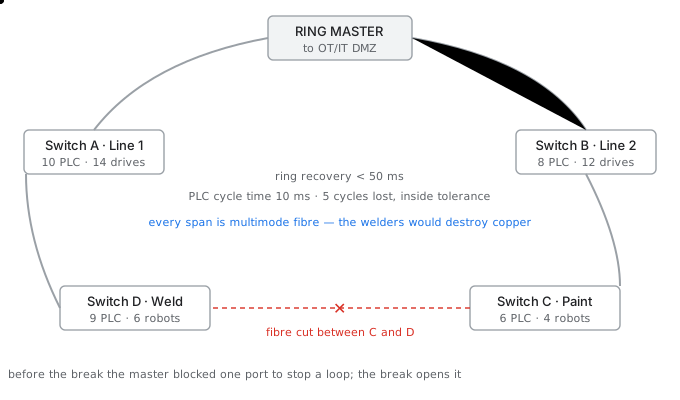
Industrial ring — the blocked port opens when a fibre breaks, so traffic wraps the other way in under 50 ms
(a)6 marks
Choose a topology for the factory floor and calculate whether its recovery time is acceptable against the control cycle.
සිංහලෙන්: කර්මාන්තශාලා බිම සඳහා ස්ථලකයක් තෝරා එහි ප්රතිසාධන කාලය පාලන චක්රයට එරෙහිව පිළිගත හැකිද යන්න ගණනය කරන්න.
Model answerආදර්ශ පිළිතුර
A ring is the correct topology for a factory floor, and it is one of the few places where a ring beats a star.
සිංහලෙන්: මුද්දක් යනු කර්මාන්තශාලා තට්ටුවක් සඳහා නිවැරදි ස්ථලකය වන අතර එය මුද්දක් තරුවකට පහර දෙන ස්ථාන කිහිපයෙන් එකකි.
The practical reason is cabling. A star needs a cable from every switch back to one central point, which on a factory floor means long runs through cable trays that machinery and forklifts damage. A ring needs only a link from each switch to its two neighbours, which follows the natural line of the production areas and uses far less cable.
සිංහලෙන්: ප්රායෝගික හේතුව කේබල් දැමීමයි. තරුවකට සෑම ස්විචයකින්ම එක් කේන්ද්රීය ලක්ෂ්යයක් වෙතට කේබලයක් අවශ්ය වේ, එයින් අදහස් වන්නේ කර්මාන්තශාලා බිමක යන්ත්ර සූත්ර සහ දෙබලක හානි සිදු කරන කේබල් තැටි හරහා දිගු ගමනක් යයි. මුද්දකට අවශ්ය වන්නේ සෑම ස්විචයකින්ම එහි අසල්වැසියන් දෙදෙනා වෙත සබැඳියක් පමණි, එය නිෂ්පාදන ප්රදේශවල ස්වභාවික රේඛාව අනුගමනය කරන අතර ඉතා අඩු කේබල් භාවිතා කරයි.
The engineering reason is that a ring is the cheapest topology that survives any single cable failure. When a span breaks, traffic simply travels the other way around, and the master switch that was blocking one port to prevent a loop unblocks it.
සිංහලෙන්: ඉංජිනේරුමය හේතුව නම්, ඕනෑම කේබල් දෝෂයකින් බේරෙන ලාභම ස්ථලකය මුද්ද වීමයි. පරතරයක් කැඩී ගිය විට, ගමනාගමනය සරලවම අනෙක් පැත්තට ගමන් කරයි, ලූපයක් වැලැක්වීම සඳහා එක් තොටක් අවහිර කරමින් තිබූ ප්රධාන ස්විචය එය අවහිර කරයි.
Recovery time against the control cycle
PLC control cycle           10 ms
tolerated consecutive misses 3 cycles = 30 ms before the line faults

ring recovery, industrial protocol (MRP / REP class)   < 50 ms
rapid spanning tree, by comparison                     1 - 3 s
classic spanning tree                                 30 - 50 s

50 ms > 30 ms tolerance  ->  a short stoppage occurs, line pauses
3 s   = 300 missed cycles ->  line faults and needs a manual restart
30 s  = 3000 missed cycles -> production batch lost

conclusion: an industrial ring protocol is mandatory.
            rapid spanning tree is 60x too slow for this application.
            to stay inside 30 ms, split into two smaller rings of
            5 switches each, recovery ~20 ms
(b)5 marks
Select the transmission medium for the ring spans and for the drop to each machine, and justify each against the environment.
සිංහලෙන්: මුදු පරාස සඳහා සහ එක් එක් යන්ත්රයට පහත වැටීම සඳහා සම්ප්රේෂණ මාධ්යය තෝරන්න, සහ පරිසරයට එරෙහිව එක් එක් සාධාරණීකරණය කරන්න.
Model answerආදර්ශ පිළිතුර
The ring spans must be multimode fibre. Welding draws hundreds of amps and switches them rapidly, and large motor drives produce broadband electrical noise, both of which couple directly into copper. Fibre carries light in glass and is completely immune to that interference, which is the property being bought here rather than the bandwidth or the distance.
සිංහලෙන්: මුදු පරාසය බහු මාදිලියේ තන්තු විය යුතුය. වෙල්ඩින් මගින් ඇම්පියර් සිය ගණනක් ඇද ඒවා වේගයෙන් මාරු කරන අතර විශාල මෝටර් ඩ්රයිව් බ්රෝඩ්බෑන්ඩ් විද්යුත් ඝෝෂාවක් ඇති කරයි, මේ දෙකම කෙලින්ම තඹ බවට පත් කරයි. තන්තු මගින් වීදුරු තුළ ආලෝකය රැගෙන යන අතර එම බාධාවන්ගෙන් සම්පූර්ණයෙන්ම ප්රතිශක්තිකරණය වේ, එය කලාප පළල හෝ දුර ප්රමාණයට වඩා මෙහි මිලදී ගන්නා දේපළයි.
The drops from a switch to an individual machine may be shielded twisted pair, provided the run is short, the shield is bonded at both ends, and the cable is routed away from the drive's motor cable. Shielded copper is chosen because industrial devices almost never have fibre ports, and because a drop of a few metres inside a cabinet is a far smaller antenna than a run across the floor.
සිංහලෙන්: ධාවනය කෙටි නම්, පලිහ දෙපස බන්ධනය වී ඇති අතර, කේබලය ධාවකයේ මෝටර් කේබලයෙන් ඉවතට හරවා යවනු ලැබුවහොත්, ස්විචයකින් තනි යන්ත්රයකට බිංදු විකෘති වූ යුගලයක් ආවරණය කළ හැකිය. කාර්මික උපාංගවලට කිසිදාක ෆයිබර් පෝට් නොමැති නිසාත්, කැබිනට්ටුවක් ඇතුළත මීටර් කිහිපයක් පහත වැටීම බිම හරහා දුවනවාට වඩා ඉතා කුඩා ඇන්ටනාවක් වන නිසාත් ආරක්ෂිත තඹ තෝරා ගනු ලැබේ.
The cable itself must be industrial grade, with a jacket that tolerates oil, coolant and continual flexing where it runs into a moving robot arm. Ordinary office patch cable cracks within months in that environment, and a cracked jacket in a paint shop is a safety problem rather than only a network one.
සිංහලෙන්: කේබලය කාර්මික ශ්රේණියේ විය යුතු අතර, එය චලනය වන රොබෝ අතක් තුළට දිවෙන තෙල්, සිසිලනකාරක සහ අඛණ්ඩ නැමීම් ඉවසන ජැකට් එකක් සහිත විය යුතුය. සාමාන්ය කාර්යාලීය පැච් කේබල් එක එම පරිසරය තුළ මාස කිහිපයක් ඇතුළත ඉරිතලා යන අතර තීන්ත සාප්පුවක ඉරිතලා ඇති ජැකට් එක ජාලයකට පමණක් නොව ආරක්ෂාව පිළිබඳ ගැටලුවකි.
Wireless is not acceptable for control traffic. A deterministic 10 millisecond cycle cannot be guaranteed on a shared, unlicensed medium that a passing forklift can block.
සිංහලෙන්: ගමනාගමනය පාලනය කිරීම සඳහා රැහැන්රහිතව පිළිගත නොහැකිය. ගමන් කරන ෆෝක්ලිෆ්ට් එකකට අවහිර කළ හැකි බෙදාගත්, බලපත්ර රහිත මාධ්යයක් මත තීරණාත්මක මිලි තත්පර 10 චක්රයක් සහතික කළ නොහැක.
(c)5 marks
Calculate the latency budget for one control cycle and state how many switch hops the design may allow.
සිංහලෙන්: එක් පාලන චක්රයක් සඳහා ප්රමාද අයවැය ගණනය කර සැලසුම මඟින් ඉඩ දෙන ස්විච් හොප් ගණන සඳහන් කරන්න.
What must fit inside 10 ms
PLC processing at each end                      2.0 ms
drive response                                  1.5 ms
safety margin, 30 % of the cycle                3.0 ms
                                  available for the network 3.5 ms

per hop, industrial switch, 100 Mbps, cut-through:
   transmission of a 100 byte control frame
        = 100 x 8 / 100 000 000 = 8 microseconds
   switch latency, cut-through   ~5 microseconds
   propagation, 100 m of fibre   ~0.5 microseconds
                         per hop  ~13.5 microseconds

3.5 ms / 13.5 us = 259 hops of pure forwarding budget
Why the real limit is much lower
the number above ignores queueing, which is what actually bites:

if one 1518 byte file-transfer frame is being sent when the control
frame arrives, the control frame waits for it to finish:
   1518 x 8 / 100 000 000 = 121 microseconds of head-of-line blocking

across 10 hops, worst case = 1.21 ms of the 3.5 ms budget

therefore:
  - keep the ring to 10 switches or fewer
  - put control traffic in a strict priority queue
  - keep file transfer and camera traffic on a different VLAN,
    and rate limit it, or it will eat the control budget
(d)5 marks
The office reporting system needs production data, but the office network must not reach the machines. Design the boundary.
සිංහලෙන්: කාර්යාල වාර්තාකරණ පද්ධතියට නිෂ්පාදන දත්ත අවශ්ය වේ, නමුත් කාර්යාල ජාලය යන්ත්ර වෙත ළඟා නොවිය යුතුය. මායිම සැලසුම් කරන්න.
Model answerආදර්ශ පිළිතුර
The boundary is a demilitarised zone between the operational technology network and the office network, and the rule that defines it is that no session ever crosses it in one hop.
සිංහලෙන්: මායිම යනු මෙහෙයුම් තාක්ෂණ ජාලය සහ කාර්යාල ජාලය අතර යුද මුක්ත කලාපයක් වන අතර, එය නිර්වචනය කරන රීතිය නම්, කිසිදු සැසියක් කිසි විටෙක එක හොප් එකකින් එය තරණය නොකිරීමයි.
A data historian server sits in that demilitarised zone. The operational side pushes production values up to the historian, and the office reporting system reads from the historian. The office never opens a connection toward the factory floor, and the factory floor never opens one toward the office.
සිංහලෙන්: දත්ත ඉතිහාසඥ සේවාදායකයක් එම යුද මුක්ත කලාපයේ වාඩි වී සිටී. මෙහෙයුම් පාර්ශවය නිෂ්පාදන අගයන් ඉතිහාසඥයා දක්වා තල්ලු කරන අතර කාර්යාල වාර්තාකරණ පද්ධතිය ඉතිහාසඥයාගෙන් කියවයි. කාර්යාලය කිසිවිටෙක කර්මාන්තශාලා බිම දෙසට සම්බන්ධතාවයක් විවෘත නොකරන අතර කර්මාන්තශාලා මහල කිසිවිටෙක කාර්යාලය දෙසට සම්බන්ධයක් විවෘත නොකරයි.
The direction matters more than the equipment. If the reporting system were allowed to query the controllers directly, a compromised office workstation would have a route to a machine that can physically move, and the firewall rule permitting that query is exactly the route an attacker would follow. Pushing data outward rather than allowing queries inward removes that path entirely.
සිංහලෙන්: උපකරණයට වඩා දිශාව වැදගත් වේ. වාර්තාකරණ පද්ධතියට පාලකයන්ගෙන් සෘජුවම විමසීමට ඉඩ දුන්නේ නම්, සම්මුතියකට ලක් වූ කාර්යාල සේවා ස්ථානයකට භෞතිකව චලනය කළ හැකි යන්ත්රයකට මාර්ගයක් ඇති අතර, එම විමසුමට අවසර දෙන ෆයර්වෝල්රීතිය හරියටම ප්රහාරකයා අනුගමනය කරන මාර්ගය වේ. විමසුම් ඇතුළට ඉඩ දෙනවාට වඩා දත්ත පිටතට තල්ලු කිරීම එම මාර්ගය සම්පූර්ණයෙන්ම ඉවත් කරයි.
A second firewall, from a different vendor if the budget allows, sits between the demilitarised zone and the office. Two different implementations are used so that a single vulnerability does not open both.
සිංහලෙන්: දෙවන ෆයර්වෝලයක්, අයවැය ඉඩ දෙන්නේ නම්, වෙනත් වෙළෙන්දෙකුගෙන්, හමුදා මුක්ත කලාපය සහ කාර්යාලය අතර හිඳියි. එක් අවදානමක් දෙකම විවෘත නොවන පරිදි වෙනස් ක්රියාත්මක කිරීම් දෙකක් භාවිතා වේ.
(e)4 marks
Design the addressing for the factory floor and explain why DHCP is not used there.
සිංහලෙන්: කර්මාන්තශාලා බිම සඳහා ලිපිනය සැලසුම් කර DHCP එහි භාවිතා නොකරන්නේ මන්දැයි පැහැදිලි කරන්න.
Plan
  10.100.0.0/22   factory floor, kept entirely separate from office space

    10.100.0.0/24    PLCs and drives, area 1 and 2   static
    10.100.1.0/24    PLCs and drives, area 3 and 4   static
    10.100.2.0/25    robots and vision systems       static
    10.100.2.128/26  industrial switches, management  static
    10.100.2.192/27  engineering laptops             DHCP, short lease
    10.100.3.0/24    OT DMZ, historian               static

  address = area number + machine number, so 10.100.0.34 is
  readable as area 0, machine 34, and matches the panel label
Model answerආදර්ශ පිළිතුර
Every machine gets a static address, and the addresses are allocated so that the last octet matches the number printed on the control panel. Controllers refer to each other by address in their own configuration, which is loaded at commissioning and not changed, so an address that moved would break the control program.
සිංහලෙන්: සෑම යන්ත්රයකටම ස්ථිතික ලිපිනයක් ලැබෙන අතර, අවසාන අෂ්ටකය පාලක පැනලයේ මුද්රණය කර ඇති අංකයට ගැලපෙන පරිදි ලිපිනයන් වෙන් කරනු ලැබේ. පාලකයන් ඔවුන්ගේම වින්යාසයේ ලිපිනයෙන් එකිනෙකාට යොමු කරයි, එය කොමිස් කිරීමේදී පටවනු ලබන අතර වෙනස් නොවේ, එබැවින් මාරු කරන ලද ලිපිනයක් පාලන වැඩසටහන බිඳ දමනු ඇත.
DHCP is avoided for a more serious reason than convention. If the DHCP server were unavailable when a line restarted after maintenance, the machines would come up without addresses and the line would not start. Static addressing removes a dependency from the critical path, and a factory floor is exactly the place where removing dependencies is worth the extra commissioning effort.
සිංහලෙන්: සම්මුතියට වඩා බරපතල හේතුවක් නිසා DHCP මග හැරේ. නඩත්තු කිරීමෙන් පසු රේඛාවක් නැවත ආරම්භ වන විට DHCP සේවාදායකය නොමැති නම්, ලිපින නොමැතිව යන්ත්ර පැමිණෙන අතර රේඛාව ආරම්භ නොවේ. ස්ථිතික ආමන්ත්රණය තීරනාත්මක මාර්ගයෙන් පරායත්තතාවයක් ඉවත් කරයි, සහ කර්මාන්තශාලා තට්ටුවක් යනු පරායත්තතා ඉවත් කිරීම අමතර කොමිස් කිරීමේ උත්සාහය වටී.
Engineering laptops are the one exception and do use DHCP with a short lease, because they are temporary visitors to the network and nothing depends on their address.
සිංහලෙන්: ඉංජිනේරු ලැප්ටොප් පරිගණක එක් ව්යතිරේකය වන අතර කෙටි කල්බදු සමඟ DHCP භාවිතා කරයි, මන්ද ඔවුන් ජාලයට තාවකාලික අමුත්තන් වන අතර ඔවුන්ගේ ලිපිනය මත කිසිවක්රඳා නොපවතී.
Keep going: ← Previous chapter · Next chapter → · Networking stage in the Self Guide
Finished this one?
Part of Self Guide · Stage 2: Networking fundamentals. Progress is saved in this browser.
Projects in this lesson
Education
Data Communication & Computer Networking Hub
Interactive TCP/IP model simulator, network design workbook, and bilingual Sinhala networking knowledge portal.
Education
AI Network Labs
A free course, graded labs and a 40-device campus capstone built around cisco-pt-mcp — the open-source MCP server for Cisco Packet Tracer by Muhammad Balawal.