The Untapped Blue Gold — Why Sri Lanka's Future Lies in Deep-Sea Fisheries & Marine Sovereignty
Why an island nation acting like a landlocked province is economic suicide, and how marine industrial scale guarantees freedom.
Volume V: Macro Futures, Sri Lanka's Horizon & Civilizational Anchors
The Geographic Absurdity of a Landlocked Mindset
Look at a satellite map of South Asia. Sri Lanka sits like an emerald tear directly in the throat of the Indian Ocean—the most congested, geopolitically vital maritime trade artery on planet Earth. More than half of the world’s container traffic, two-thirds of global petroleum shipments, and half of the world's maritime dry bulk pass within sight of the southern lighthouse at Dondra Head.
Under international maritime law, Sri Lanka’s Exclusive Economic Zone (EEZ) covers over 517,000 square kilometers of ocean—an expanse nearly eight times larger than our entire terrestrial landmass. Beneath those warm, nutrient-rich equatorial currents lie vast migratory corridors of yellowfin tuna, skipjack, deep-sea billfish, polymetallic seabed minerals, and untouched hydrocarbon deposits.
Yet, examine the tragic, absurd reality of Sri Lankan economic policy for the past seven decades. National leadership and Colombo economists have treated the country as if it were a landlocked, resource-poor mountain province like Nepal or Bhutan. They obsess perpetually over low-margin garment assembly, tea auctions, and volatile foreign remittances, begging the International Monetary Fund for another bailout loan while sitting on top of an oceanic goldmine.
How I see things is that our economic crisis is fundamentally an imaginative failure. We have turned our backs on the sea. The day we reclaim our marine sovereignty and industrialize our deep-sea waters is the day we break the cycle of debt and assert our rightful place as an Indian Ocean power.
The Tragedy of the Coastal Fisherman
During my travels along the eastern and southern coastlines—from the natural deep-water harbor of Trincomalee down to the rocky headlands of Tangalle—I spent hours watching local fishermen launch their wooden outrigger canoes (oruva) and fiberglass dinghies through the surf. Their physical courage is awe-inspiring, but their operational reality is heartbreaking.
Because of decades of policy neglect, Sri Lanka’s domestic fishing fleet remains overwhelmingly primitive. Most local operators are trapped within a five-to-fifteen-mile coastal band, using small, un-refrigerated boats with outboard motors. They lack modern sonar arrays, satellite sea-surface temperature telemetry, and proper ice preservation facilities. By the time they haul their catch back to the beach under a blazing tropical sun, thirty to forty percent of the harvest has suffered enzymatic degradation, destroying its value for lucrative international sushi-grade export markets.
Meanwhile, look twenty miles farther offshore into our sovereign EEZ. Hundreds of massive, high-tech foreign distant-water industrial trawlers—flying foreign flags—brazenly plunder our marine resources. Equipped with onboard blast-freezing tunnels, factory processing decks, and long-range radar, they vacuum up billions of dollars in premium tuna and pelagic species every single year, while our naval patrols are too under-resourced to enforce border sovereignty. We are starving on a feast.
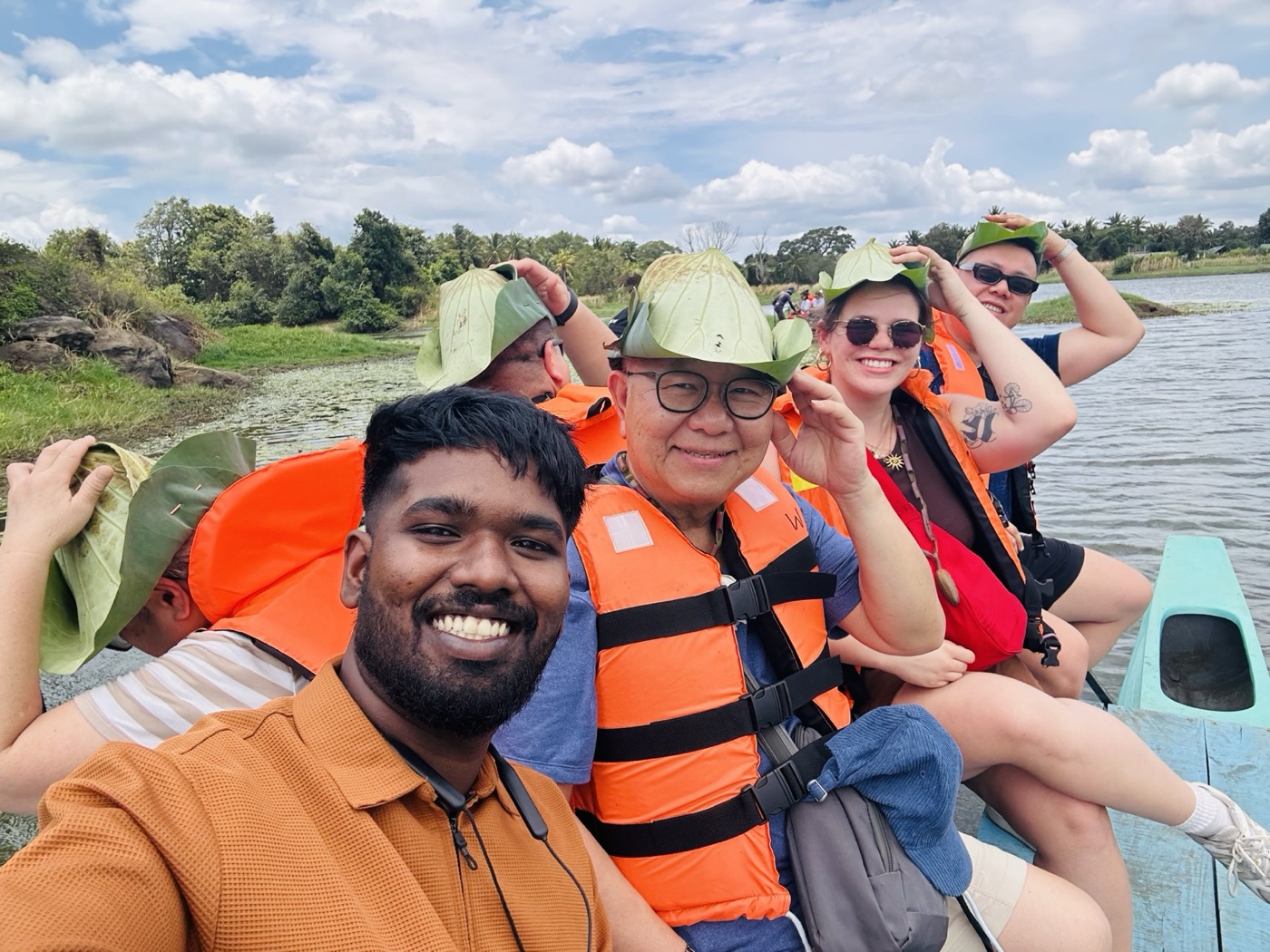
Guiding travellers on a boat safari.
The Industrial Blueprint for Marine Sovereignty
To unlock our blue gold, Sri Lanka must execute a comprehensive, high-agency industrial marine strategy modeled after maritime powerhouses like Norway, Iceland, and Japan.
First, modern fleet capitalization. The state must stop subsidizing kerosene for primitive coastal dinghies and instead provide long-term capital financing for modern, 40-to-60-foot multi-day deep-sea vessels equipped with insulated slurry-ice holds, satellite tracking, and humane long-line gear that prevents bycatch. One modern vessel operating on the high seas generates more export value in a single voyage than fifty coastal canoes produce in a month.
Second, domestic cold-chain infrastructure. We must transform coastal harbors—Trincomalee, Galle, Hambantota, and Dikkowita—into state-of-the-art marine industrial clusters. This requires solar-powered blast-freezing warehouses, value-added canning and filleting factories, and direct air-freight cold chains connecting harbors to Tokyo, London, and New York. Exporting raw, un-processed whole fish is economic folly; exporting premium, packaged, certified sushi loins commands a tenfold value multiplier.
Third, sovereign maritime surveillance. Deploying low-cost autonomous marine drones, satellite automatic identification systems (AIS), and naval interceptors to defend our EEZ. Every foreign vessel plundering Sri Lankan waters must be arrested and confiscated. Marine sovereignty is not just about fish; it is about national defense.
The Strategic Geometry of Ports: Trincomalee, Colombo, and Hambantota
Sri Lanka's marine destiny is inextricably linked to our harbor infrastructure. Trincomalee possesses the world's fifth-largest natural harbor—a deep-water bay so sheltered and vast that entire naval armadas can anchor within its arms. For centuries, colonial powers fought bloody naval wars to control Trincomalee, yet today it sits largely dormant, surrounded by rusted oil tanks and bureaucratic neglect.
Similarly, the Port of Colombo is already one of the premier transshipment hubs in South Asia, handling millions of TEU containers annually for the Indian subcontinent. Yet we capture only a fraction of the value chain: simple crane-lifting fees rather than high-margin maritime bunkering, ship repair, marine insurance, and bonded manufacturing.
By integrating deep-sea industrial fisheries with modern maritime logistics clusters across Trincomalee, Colombo, and Hambantota, Sri Lanka can establish an unshakeable geopolitical moat. We become not a beggar nation pleading for foreign aid, but an indispensable oceanic trade and resource titan that commands respect from every global superpower navigating the Indo-Pacific.
How I See Things: The Blue Verdict
How I see things is that Sri Lanka’s destiny was never meant to be confined to the soil. We are children of the Indian Ocean. The roaring surf of our coastline is an invitation, not a wall.
Cast off the small-minded, landlocked mentality that has kept this island in chains. Look out beyond the breakers toward the vast, azure horizons of our sovereign waters. Invest in the steel hulls, the cold chains, and the naval resolve. When we claim our blue gold, Sri Lanka will finally realize the greatness that geography bestowed upon her.
Keep going: ← The Disruption of Sri Lankan Tourism · Granite Endurance →