W3DevOps
Interactive DevOps & Cloud Engineering Handbook
Comprehensive interactive W3Schools-style DevOps documentation, practical labs, and cloud architecture portal.
Overview
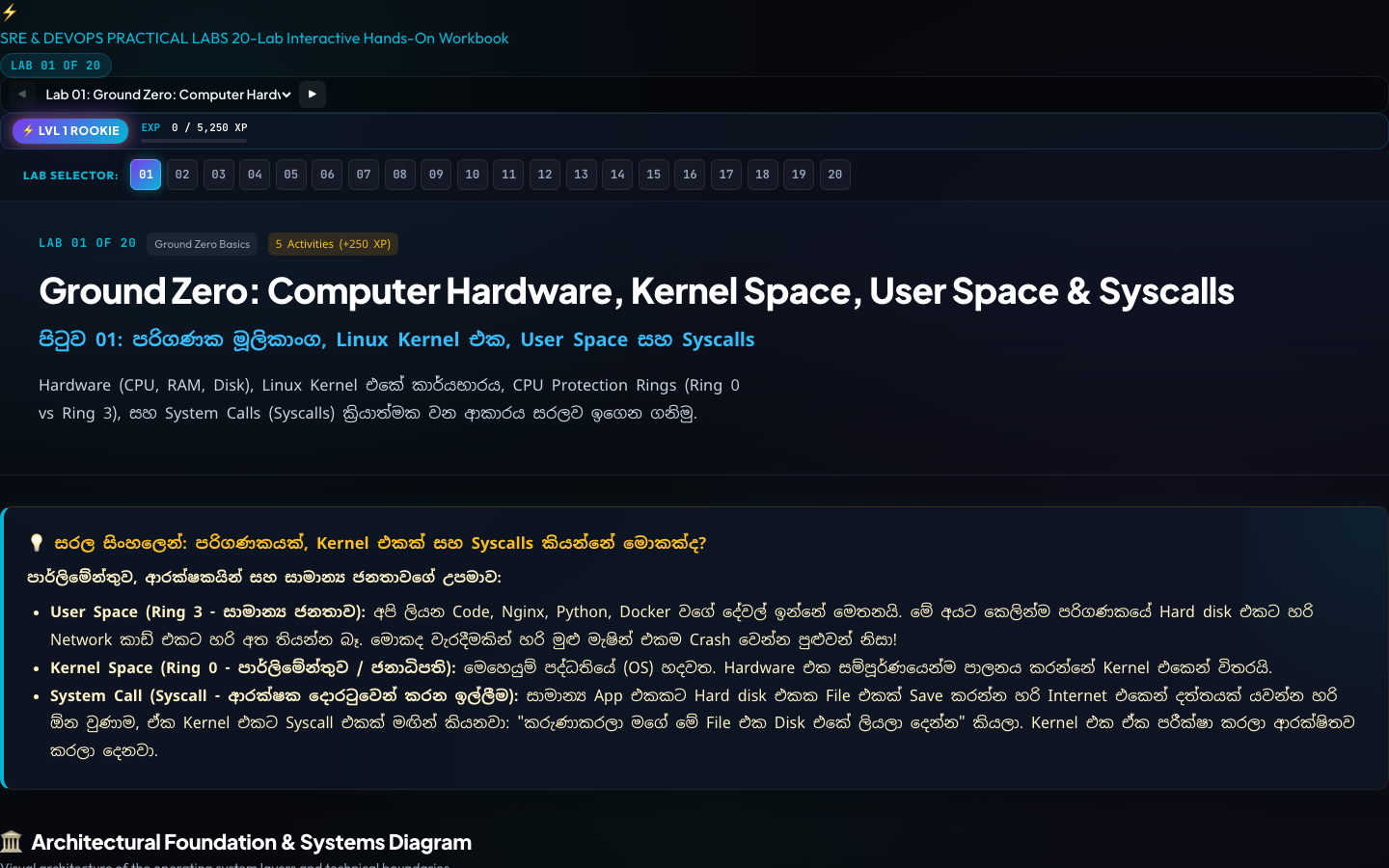
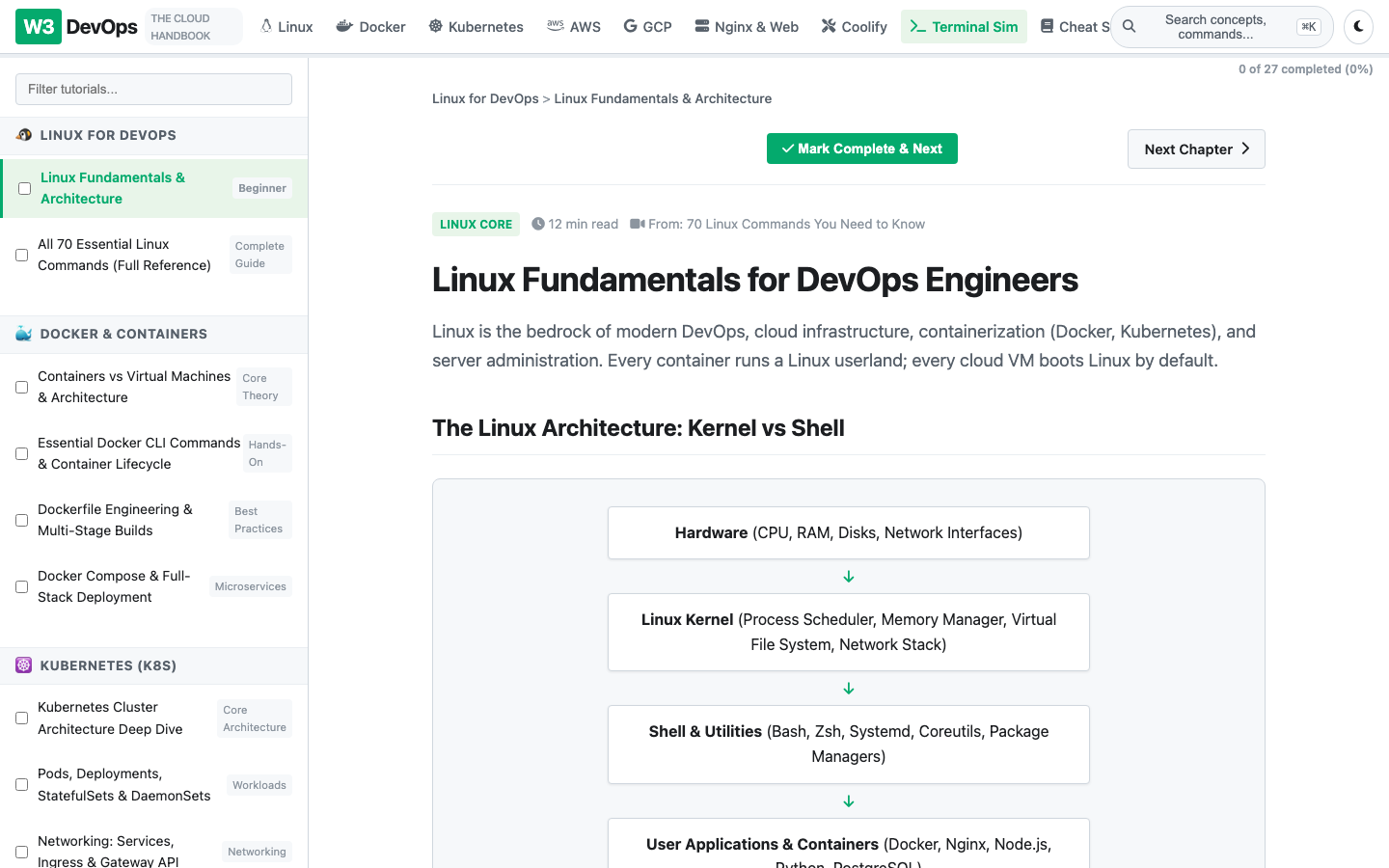
W3DevOps is an interactive, multi-module DevOps encyclopedia and training platform modeled after W3Schools. Built to distill enterprise cloud infrastructure into visual, self-paced documentation, it features over 130 step-by-step illustrated guides spanning cloud hosting (Coolify, AWS), container orchestration (Kubernetes, Docker), Linux systems engineering, and network security.
Design decisions
The choices that shaped the system, and why.
- 1
Why Self-Hosted Coolify on GCP over expensive Managed AWS ECS/EKS?
Built hands-on production experience deploying Coolify v4 on a Google Cloud Compute Engine instance (`shantha` in `us-central1-b`). This delivered full PaaS convenience (Git push to deploy, automated SSL, wildcard DNS) on a sub-$10/month compute budget.
- 2
Why Raw Screenshot Captures of Real Terminal Failures?
Rather than presenting sanitized theory, the documentation includes 136 production screenshots capturing real SSH authentication debugging, firewall permission errors, and container crash loops, making it an invaluable troubleshooting bible.
- 3
Zero-Framework Static Architecture
Kept the portal 100% dependency-free HTML/CSS/JS so it can be hosted on AWS S3 + CloudFront for fractions of a cent per month with zero server maintenance.
Architecture
Modular Documentation Engine
High-performance static architecture with responsive sidebar navigation, real-time code search, and instant topic filtering.
Step-by-Step Production Screenshots
Integrated documentation archive with 136 production screenshots capturing real CLI terminals, cloud consoles, and topology graphs.
Interactive Lab Snippets
Live copyable shell commands, Dockerfiles, YAML manifests, and Nginx reverse proxy configurations.
DevOps Curriculum Coverage
Covers Linux systems administration (shred, sed, awk), AWS architecture (ALB, VPC, IAM), Docker containerization, Kubernetes clusters, and self-hosted Coolify PaaS deployments.
DevOps & deployment
Tested and deployed across GCP Compute Engine (`34.9.32.243`), AWS S3 Static Website Hosting with CloudFront CDN, and local Docker Nginx containers.
Features
- Over 130 richly illustrated tutorial modules with real terminal outputs and console snapshots.
- Coolify self-hosted deployment guides: VPS provisioning, DNS routing, SSL certificates, and Docker registry integration.
- AWS Solutions Architecture breakdowns: Application Load Balancers, Multi-AZ subnets, security groups.
- Comprehensive Linux command reference with security-hardened practices.
Screenshots
Related writing
DevOps · 4 min
Paying for Cloud as a Student: Budgets, Static Sites and a $10 PaaS
Budget alerts first, static by default, the minimums that quietly bill you, load balancers vs Ingress, and running a dozen apps on one Coolify VM.
23 Oct 2026
DevOps · 4 min
W3DevOps Module · Coolify: A Sub-$10/Month PaaS, Step by Step
Why I run my own Heroku-style PaaS on a single GCP VM, how Coolify works under the hood (Docker + Traefik + SSH), and the five-step process for connecting extra servers — with the real screenshots.
14 Jul 2026
DevOps · 4 min
W3DevOps Module · Production web: DNS, SSH Hardening, Nginx Reverse Proxy, Let's Encrypt and CDNs
How a domain name becomes a running app: DNS resolution, bare metal vs VMs, SSH hardening, a complete Nginx reverse-proxy config with load balancing, TLS and WebSockets, and S3 + CloudFront for static sites.
7 Jul 2026
DevOps · 4 min
W3DevOps Module · Google Cloud: Resource Hierarchy, Compute Engine, Cloud Storage and GKE
The GCP track of my handbook — the platform most of my projects actually run on. Organisation → folders → projects, gcloud, e2 VMs and Managed Instance Groups, GCS storage classes and GKE Autopilot vs Standard.
30 Jun 2026